In just over two years, nearly every piece of my rabbit’s setup has been replaced at least once. The hay feeder lost its crown to a $15 plastic bin. The water setup went through three versions. The housing itself, four. Each of those stories has its own post on this site — this post is the tour that puts them all in one place: everything currently in my Netherland Dwarf’s enclosure, why each item earned its spot, and the link to the full story if you want the details.
If you’re setting up for a new rabbit, steal freely. This list is what survived.
The enclosure: opaque DIY panels
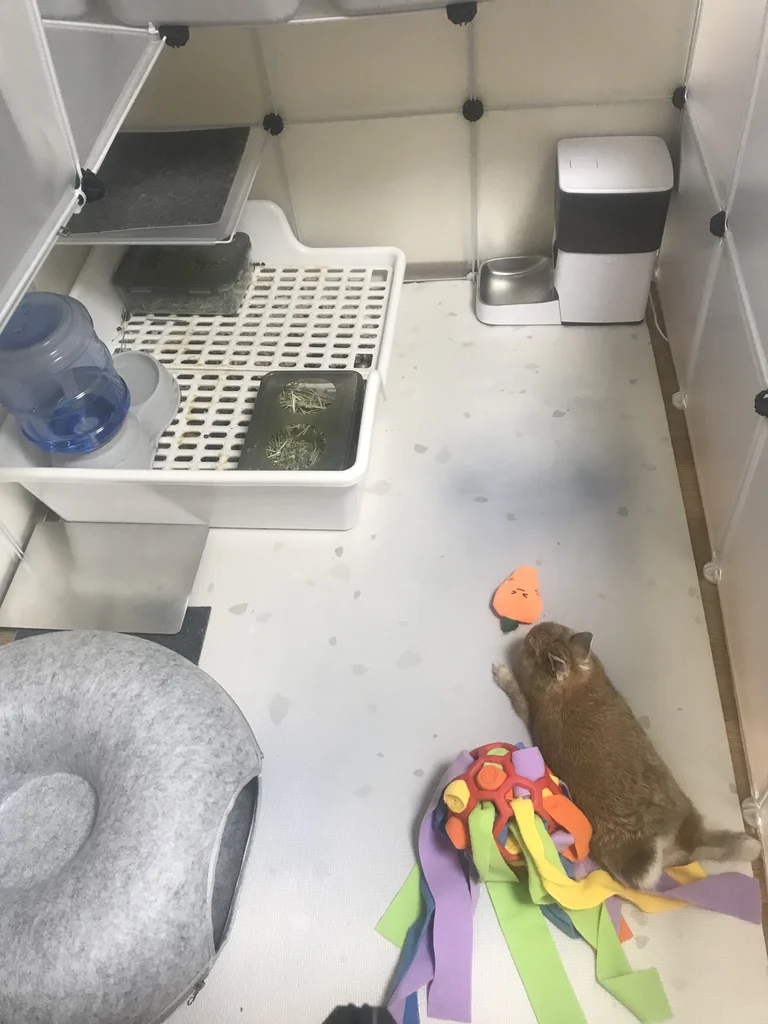
The foundation is a DIY enclosure built from opaque square panels — not a cage, not free roam, but a defined territory shaped to our room. Mine is built from 45 cm panels in a 3×4 footprint (roughly 1.4 × 1.8 m), with walls two panels high and a partial ceiling. Solid walls keep fur and hay inside; the modular panels let the enclosure fit the space instead of the other way around. A mid-level platform between the wall tiers gives him something to hop onto and survey his territory from. We arrived here after a full year of free roaming, and the move was an upgrade for both of us.
The floor: cushion mats
Under everything, cushion mats. Rabbits have no paw pads — their soles are fur over skin — so soft, non-slip flooring isn’t decor, it’s prevention against pressure sores (sore hocks). Cheapest health equipment in the whole setup.
The litter box
The single highest-return item in rabbit care. A reliable litter box habit is what makes everything else easy — it concentrates virtually all cleanup into one corner and is the reason my enclosure barely needs cleaning at all.
The hay station
Unlimited timothy hay is the core of the diet, served from a $15 plastic bin that beat a $30 metal rack — side-opening, low-waste, boring in the best way. Hay is also, honestly, the best toy in the enclosure.
The water station: 3L semi-automatic dispenser
Bowl-based drinking (the veterinary references are clear rabbits drink more from bowls than bottles) with a 3-liter reservoir doing the refilling. The bowl never runs dry; I never have to remember it midweek. In summer, that buffer doubles as a safety net.
The pellet feeder
One automatic feeder, downsized from two after I finally compared pellet labels and consolidated to a single brand. About 6 grams twice a day — pellets are the side dish, hay is the meal. The retired brand lives on in the treat tin.
The toy corner (it’s small)
Exactly two toys survived two years: a carrot plush and a snuffle ball. Everything hard, plastic, or designed for dogs failed — one of them within a week. A rabbit’s entertainment budget is smaller and softer than the pet store suggests.
The hideout: a felt donut (the newest resident)
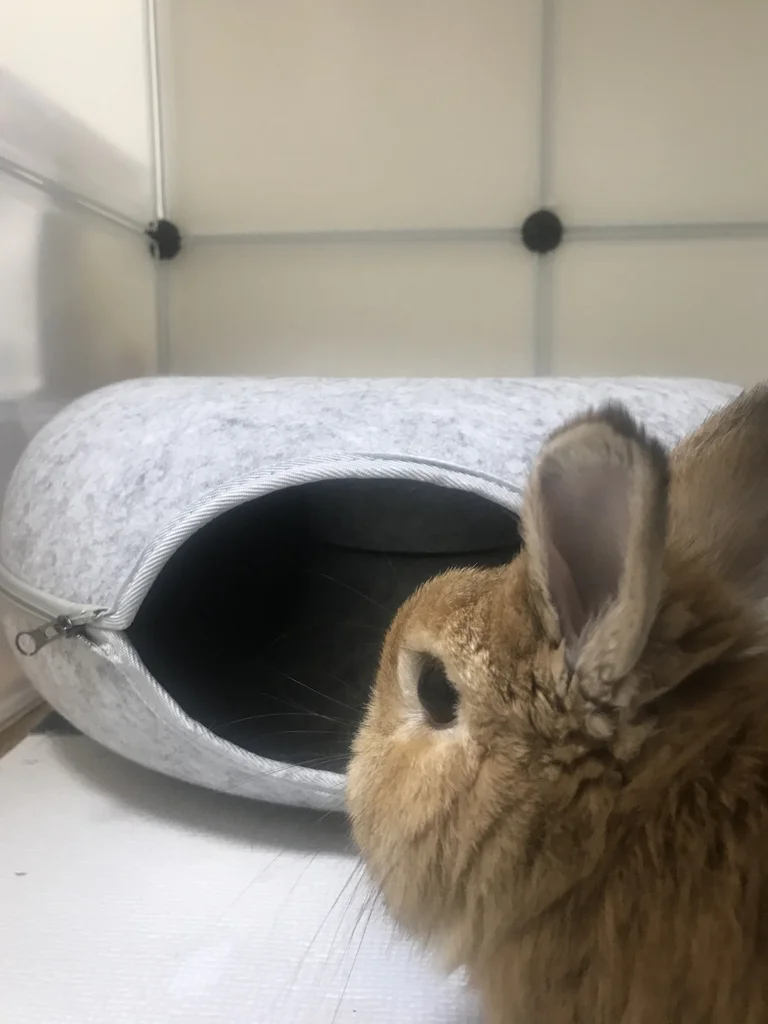
For most of these two years there was no dedicated hideout — the opaque walls already gave him the privacy that hideouts are supposed to provide, and he seemed to feel secure enough to flop in the open. The recent addition is a gray felt donut-shaped hideout, and it passed the only review that matters: he climbed in and flopped. If your enclosure has see-through walls, I’d move a hideout much higher up the shopping list.
Seasonal gear: summer
When it gets hot, the air conditioning stays on and ice packs go into the enclosure — the full routine is in the heat stroke post. (The cooling mat I bought turned out to be summer bedding, not heat protection.) Rabbits can’t sweat; summer is the one season the setup has to actively fight.
Maintenance: lighter than you’d think
With the litter box carrying 90% of the load, upkeep is mostly hay sweeping and fur patrol — the full cleaning routine takes minutes, plus a regular brushing routine that cuts the fur problem at the source.
What’s deliberately NOT in the setup
- A wire-floor cage. Wire floors are the classic cause of sore hocks. The whole “cage” concept got replaced by the enclosure.
- A sipper bottle. Bowls beat bottles for intake; the dispenser gives bottles’ capacity without the nozzle.
- Hard plastic toys. Rabbits explore everything with their teeth, and they’re not gentle about it — mine would bite his plastic treat dispenser and slam it against the floor, hard enough that chipped teeth and swallowed plastic shavings stopped being hypothetical. I threw it out within a week, before the injury happened rather than after. See: the toy that lasted a week.
- A harness. Bought one, my rabbit vetoed it, and it went in the trash.
The bottom line
Two years of iteration compress into one principle: build a territory, not a cage. Solid walls, soft floor, one good litter box, unlimited hay, open water, a tiny toy budget, a hideout he actually uses, and a seasonal plan for heat. Every item on this list earned its place by outlasting a worse version of itself — which is exactly the review process I’d recommend: buy modestly, watch your rabbit, and let the survivors write your setup guide.
And once the territory is built, running it takes surprisingly little. My full rabbit care routine is the companion post to this one — everything I actually do daily, weekly, and almost never.