
For almost two years, my Netherland Dwarf ate two brands of timothy pellets side by side — Oxbow and Genesis, each in its own feeder, morning and night. Last week I retired one of them. Not because of a bad batch, not because he stopped eating it, but because I finally sat down and compared the actual guaranteed analysis on the two labels.
If you just want the short version: the number that decided it was crude fiber — 25–29% versus 18% — and the biggest lesson wasn’t even about the brands. It was that the numbers floating around online didn’t match the numbers printed on my bags. The rest of this post is the comparison, the three reasons I picked the winner, and the two places where “sources” got the facts wrong.
How pellets fit into his day (they’re a side dish)
First, context, because pellet brand matters a lot less than pellet quantity. My rabbit gets about 6 grams of pellets twice a day — 8 in the morning, 8 at night. That’s it. The bulk of his diet is unlimited timothy hay, which is exactly how it should be for an adult rabbit. Pellets are the multivitamin on top, not the meal. (The complete daily menu — hay, pellets, one treat, no vegetables — is written up in one place.)
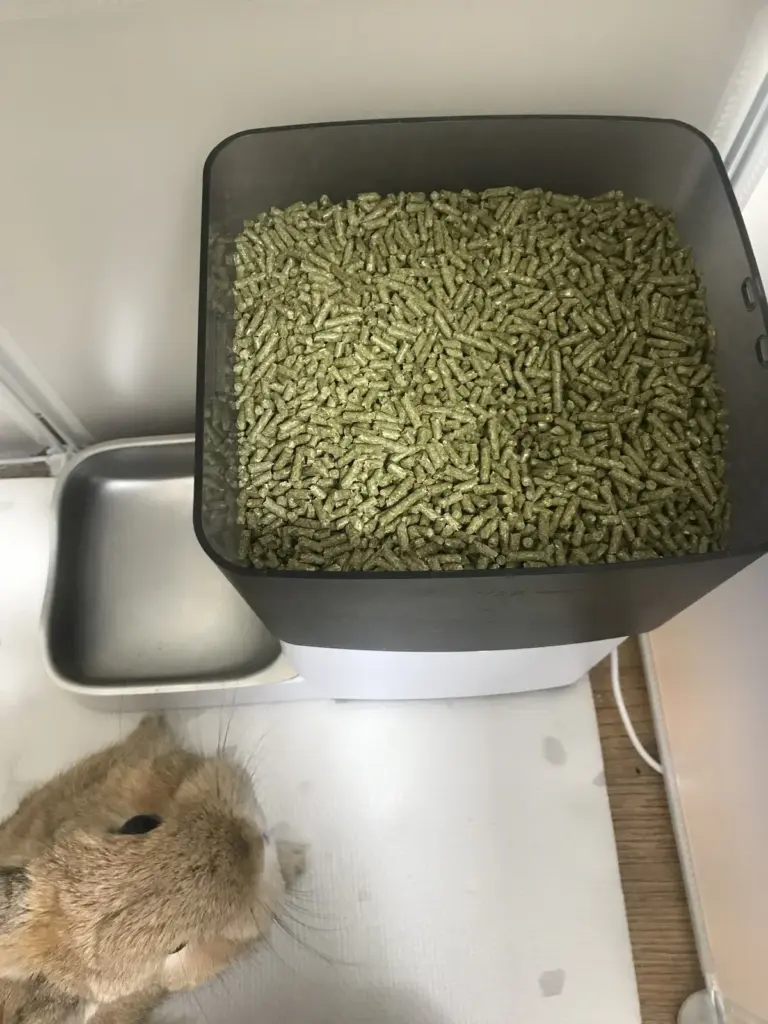
Like most owners, I started him on alfalfa-based pellets as a baby — alfalfa versions of these same two brands — and switched to the timothy versions at around six months. Since then, both foods had simply… stayed. Two automatic feeders in the enclosure, one loaded with Genesis, one with Oxbow, running in parallel for years. Nobody ever made me choose. So I never did.
What made me finally compare them
The trigger was mundane: one day I simply got curious which of the two foods was actually better for him, and started looking it up online. The search results were full of confident, specific percentages. Then I did something I recommend to everyone: before throwing out the old bags, I checked the guaranteed analysis printed on the actual packaging.
Some of the numbers I’d found didn’t match the labels. One AI-generated summary at the top of my search results quoted a crude fiber of 22.5% and calcium of 0.6% — neither figure appears on either bag. That turned idle curiosity into a real comparison: I pulled the official guaranteed analysis from both manufacturers’ websites, and put them next to what veterinary references actually recommend.
The numbers, side by side
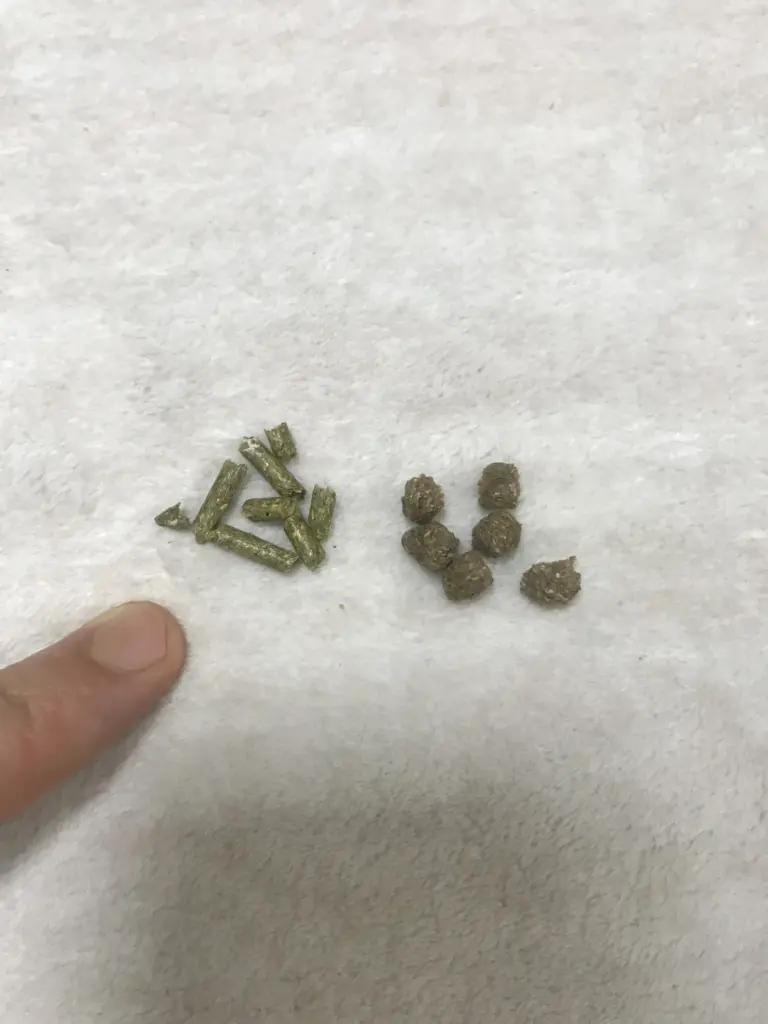
My benchmark is the Merck Veterinary Manual’s rabbit nutrition guidance for adult (maintenance) rabbits. Here’s how the two foods stack up against it, using each manufacturer’s own published guaranteed analysis:
| Merck (adult) | Oxbow | Genesis | |
|---|---|---|---|
| Crude fiber | 14–20%+ | 25–29% | 18% |
| Crude protein | ~12% | 14% (min) | 15% |
| Crude fat | 1.5–2% | 2% (min) | 2.5% |
| Calcium | 0.4–0.5% | 0.35–0.75% | 0.80% |
| 1st ingredient | — | Timothy grass meal | Timothy hay |
| Alfalfa? | avoid for adults | No | Yes |
| Added calcium? | — | No | Yes |
Both are legitimate timothy-based pellets for rabbits — this isn’t a hit piece on Genesis, which my rabbit has eaten happily for years. But looking at the table, the decision made itself.
The three reasons Oxbow won
1. Fiber, fiber, fiber. Fiber is the whole point of a rabbit’s diet — it’s what keeps their gut moving. Oxbow guarantees 25–29% crude fiber; Genesis lists 18%. Genesis clears Merck’s minimum, but Oxbow clears it by a mile. For an animal whose most common health emergency is GI stasis, I’ll take the mile.
2. No alfalfa in the ingredients. Genesis Timothy lists dehydrated alfalfa meal among its ingredients. Alfalfa isn’t poison — babies eat it — but per Merck, long-term alfalfa feeding in adult rabbits is associated with excess calcium intake and urinary tract problems. In a food I plan to feed every single day for years, I’d rather it simply not be there.
3. No added calcium compounds. Genesis adds calcium carbonate and dicalcium phosphate; Oxbow’s list has neither. To be fair about the actual numbers: Oxbow publishes calcium as a range (0.35–0.75%) while Genesis lists a flat 0.80%, so I can’t claim a dramatic difference — a bag of Oxbow at the top of its range isn’t far below Genesis. But the ceiling sits closer to Merck’s 0.4–0.5% target, and the calcium comes from the plants rather than from supplements stacked on top.
What Oxbow is not (the honest part)
Reading the Oxbow label also killed a story I’d half-believed: that it’s somehow “pure timothy.” It isn’t. After timothy grass meal, the ingredients include soybean hulls, soybean meal, cane molasses, and wheat middlings. Genesis has its own version of the same supporting cast — wheat, barley, soybean meal.
So if you’re comparing these two hoping one of them is a clean single-ingredient food, neither is. That’s fine — pellets are a formulated supplement, not hay — but it means “which has grains?” is the wrong question. Both do. The meaningful differences are the ones in the table: fiber, alfalfa, added calcium.
The part that surprised me: my bag didn’t match the website
Here’s the twist I didn’t expect. I live in Korea, and the guaranteed analysis on my Korean-market Oxbow packaging lists calcium at max 0.85% and vitamin A at 19,000 IU/kg. Oxbow’s official US product page lists max 0.75% and 10,000 IU/kg for the same product line.
I don’t know whether that’s a regional formulation difference or a labeling artifact, and I’m not going to pretend I do. But it taught me the rule I now actually follow: the label on your bag beats the website, and the website beats whatever an AI or a search snippet tells you. In one afternoon of checking, I found mismatches at both levels. If a specific number matters for your rabbit — say your vet flagged calcium — read your own packaging.
An unexpected bonus: two feeders became one
Since each brand had its own automatic feeder, feeding two foods meant two feeders taking up floor in his enclosure. Consolidating to one food let me remove one of them, and honestly, this might be my favorite outcome of the whole exercise.
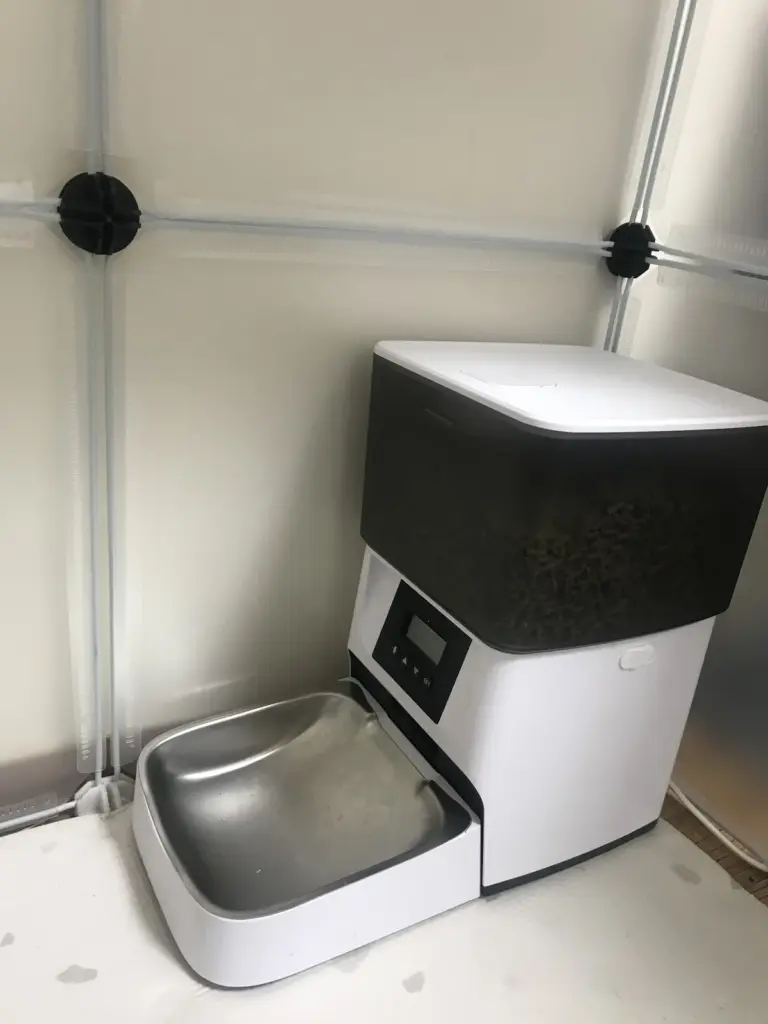
He got the floor space back — more room to flop and stretch in the enclosure. And I lost one of the two spots where dust and fur constantly collected around a feeder base. I expected the nutrition upgrade; I didn’t expect the housekeeping upgrade.
Where Genesis went: the treat tin
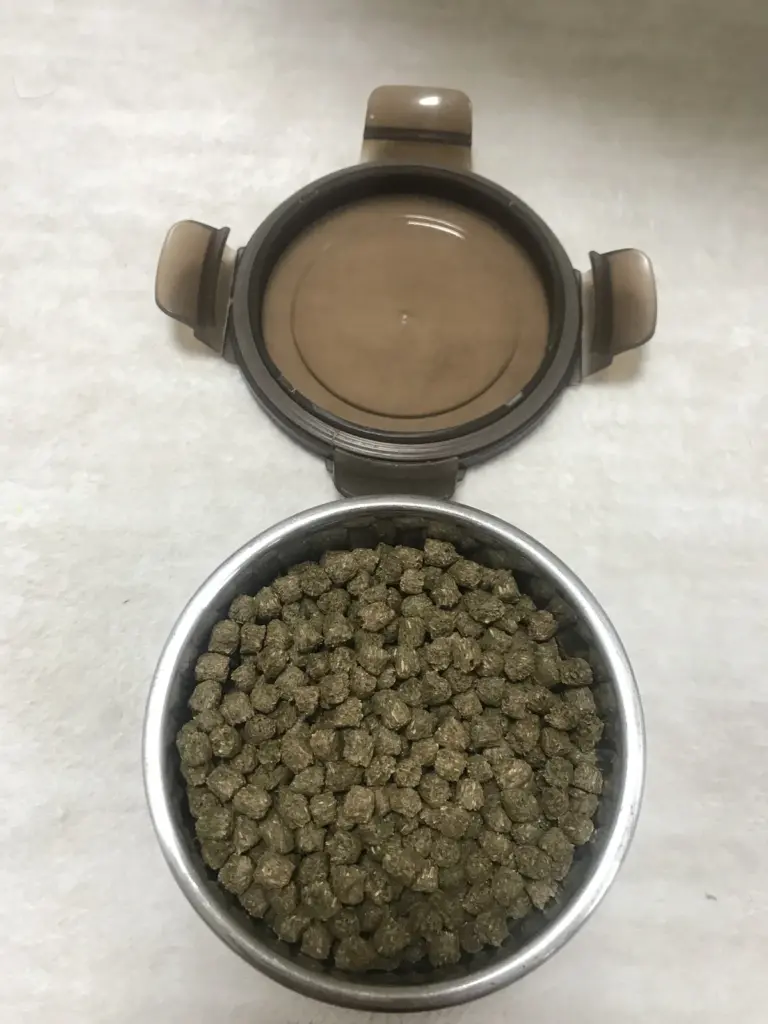
The leftover Genesis didn’t go in the trash. It went into a small metal tin, and it’s now his “treat” — which works perfectly, because to a rabbit, a pellet of anything is exciting. If you’ve read my safe treats post, you know my philosophy: the best treats are boring, dry, and rationed. A tin of familiar pellets fits that exactly — I hand him three to five pellets at a time, zero sugar drama, and he sprints for them like it’s dessert.
The bottom line
If you’re standing in front of these two foods (or any two rabbit pellets), here’s my two-year, two-brand takeaway:
- Compare crude fiber first. Higher is better for an adult rabbit; 25–29% vs 18% was the single biggest gap between these two.
- Scan the ingredients for alfalfa and added calcium compounds if you’re feeding an adult every day.
- Trust your bag’s label over the internet. Including, and especially, AI summaries. I found wrong numbers twice in one afternoon.
- Don’t overthink the loser. A decent second-place pellet makes a great treat.
Nobody paid me for this comparison — I bought both brands with my own money and fed both for years. That’s exactly why I trust the result.
This post is part of my complete rabbit setup — a tour of everything currently in his enclosure and why each item survived.