Let me save you some time: I owned a rabbit harness. It was purchased with the best intentions, my Netherland Dwarf rejected it absolutely, and it went in the trash without ever being used for an actual walk. This post is about why I’ve made peace with that — and what I use instead when he genuinely needs to go somewhere.
If you came here for “which harness should I buy,” here’s my honest answer: first make sure the walk is for your rabbit and not for you. Mine told me clearly it wasn’t — and the more I learned about rabbits, the more sense his answer made.
The harness experiment (duration: minutes)
The fantasy is easy to buy into — social media is full of rabbits hopping through parks on little leads. So I bought a proper rabbit harness and introduced it to my rabbit.
He wanted nothing to do with it. Not “needs time to adjust” resistance — flat refusal. The moment I tried to slip it on, he kicked and thrashed like I was attaching a predator to his back. I tried about three times, and the answer never changed. Could I have forced it on him? Physically, yes — he’s a Netherland Dwarf, I would have won. But a walk that begins with pinning down a struggling prey animal has already failed at its own premise.
I know the standard advice is to desensitize slowly over weeks — it’s the same principle I used when teaching him to be held, and for some rabbits it works on harnesses too. But watching his stress, I asked myself a more basic question first: who is this walk actually for?
Rabbits are territorial — walks are a human idea
Dogs are roaming animals; new places are enrichment. Rabbits are the opposite: territorial prey animals. A rabbit’s well-being is built on a known, controlled territory — his smells, his sightlines, his escape routes. Take that away and put him in an open, unfamiliar outdoor space, and what a human reads as “adventure” a rabbit can experience as sustained exposure. Every unfamiliar sound is a potential predator; the freeze-and-scan behaviors you’ll see outside aren’t curiosity, they’re alarm.
Some individual rabbits do genuinely tolerate or enjoy supervised outdoor time — I’m not claiming yours can’t. I’m saying the burden of proof is on the walk, not on the rabbit. Mine voted, and I listened.
The health fine print nobody posts on Instagram
There’s also a medical reason to take outdoor time seriously rather than casually. Outdoor exposure — especially anywhere wild rabbits have been — carries disease risk, and the big one is RHDV2 (rabbit hemorrhagic disease), which is highly contagious and frequently fatal. The Merck Veterinary Manual notes that RHDV2 vaccination is especially important for rabbits that go outside in areas where wild rabbits have been.
So if you do decide to walk your rabbit: talk to your vet about vaccination first. An unvaccinated rabbit on a lawn is taking on real risk for a stroll he may not even want. That single fact reframed the whole harness question for me — outdoor time isn’t a free activity you unlock with a $15 strap; it’s a decision with a medical checklist attached.
What I use instead: a backpack carrier
Here’s the thing: my rabbit still needs to leave the house sometimes — vet checkups, and once, a house move. For that, the gear that actually earns its keep is a backpack-style pet carrier with a transparent front panel.

Why it works better than a harness ever would for us:
- It’s an enclosed space, not an open one. Small, bounded, den-like — much closer to what a rabbit finds safe than the open ground of a park.
- He can see out; nothing can get in. The transparent panel gives him information without exposure.
- Ventilation is built in, not improvised. Grommet vents and a zip-open mesh window on the side, plus a mesh back panel — airflow without opening him up to the world.
- I wear it on my front. He rides at chest height where I can see him and talk to him, not bouncing on my back. In the car, the carrier sits on the passenger seat.

And here’s the honest usage report: it comes out once or twice a year. A vet checkup, a house move — that’s the whole list. “Rarely used” and “essential” aren’t opposites, though. When your rabbit genuinely has to travel, nothing else does the job safely, and you don’t want to be improvising with a cardboard box on the day it matters.
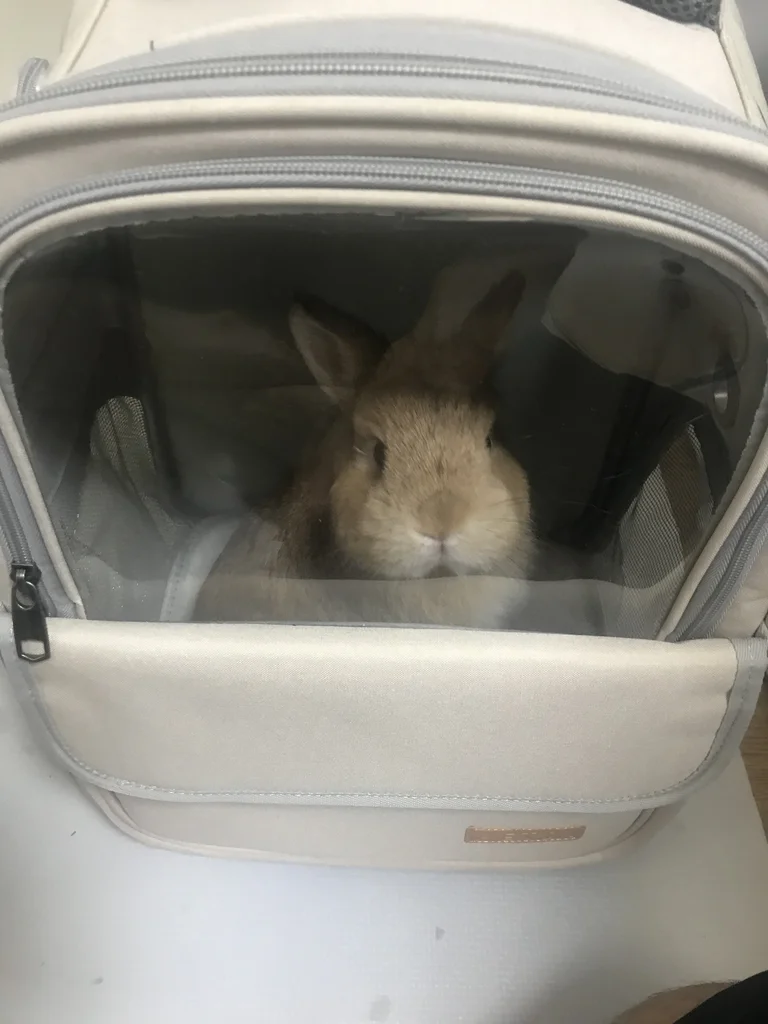
The carrier doesn’t pretend to be enrichment. It’s transport — calm, contained, over quickly. That honesty is exactly why it works.
The bottom line
My harness went in the trash, and I don’t consider that a failure. If your rabbit takes to a harness calmly, with a vet’s blessing and vaccination handled — enjoy it, genuinely. But if your rabbit refuses, hear him: he’s not being difficult, he’s being a rabbit. Enrichment happens in his territory. Transport happens in a carrier. The park was always our idea.
As always, I bought both the harness and the carrier with my own money — only one of them earned the right to stay.