Here’s the fact that reorganized how I feed my rabbit: rabbit teeth never stop growing. Not just the front ones you can see — all of them, incisors and molars alike, for the animal’s entire life. My Netherland Dwarf has never had a single dental problem in our two years together, and this post is about the strange reason why: a two-hour conversation with a vet, and a diet that quietly doubles as dental care.
The two-hour consult I didn’t plan
I originally went to the clinic to ask about neutering. What I got was closer to a masterclass. The vet — clearly someone who genuinely loves rabbits — sat with me for about two hours and walked me through far more than the surgery. I didn’t ask a single question about teeth. He brought them up on his own, unprompted, as one of the first things a rabbit owner needs to understand.
Most of what I know about rabbit dental care traces back to that conversation. Here’s his explanation, the way it stuck with me.
The problem: teeth that outlive the bones around them
A rabbit’s teeth are open-rooted — they grow continuously, and their length is only kept in check by grinding against the opposing teeth. The Merck Veterinary Manual puts it in one line: the incisors, premolars, and molars of rabbits grow throughout life, and normal length is maintained by the wearing action of opposing teeth.
The part of the vet’s explanation I’ve never forgotten was about aging. As a rabbit gets old, he said, everything else weakens — the bones of the face and jaw gradually lose density, the way bones do in any aging animal. But the teeth don’t get the memo. They just keep growing. So in an older rabbit with unchecked teeth, you have an ever-growing structure anchored in ever-weakening bone. Overgrown teeth and their roots can push where they were never meant to go — into the jaw, or up toward the eye. In the worst cases, he told me, a rabbit can lose vision this way.
That’s not just one vet’s scare story. Merck’s dental section notes that dental abscesses in rabbits can appear as retrobulbar abscesses — behind the eyeball — and advises that a rabbit showing eye symptoms like tearing or a bulging eye should get a full dental exam. When a rabbit’s eye is in trouble, one of the first places a good vet looks is the mouth. The plumbing of a rabbit’s skull is that connected.
And unlike the inherited misalignment some rabbits are born with, the version that develops over a lifetime is largely a husbandry problem. Merck is blunt about this too: overgrowth of the cheek teeth is usually due to malnutrition or other mistakes in husbandry. In other words — it’s usually the owner’s diet choices, which means it’s usually preventable.
The fix is not a product — it’s hay
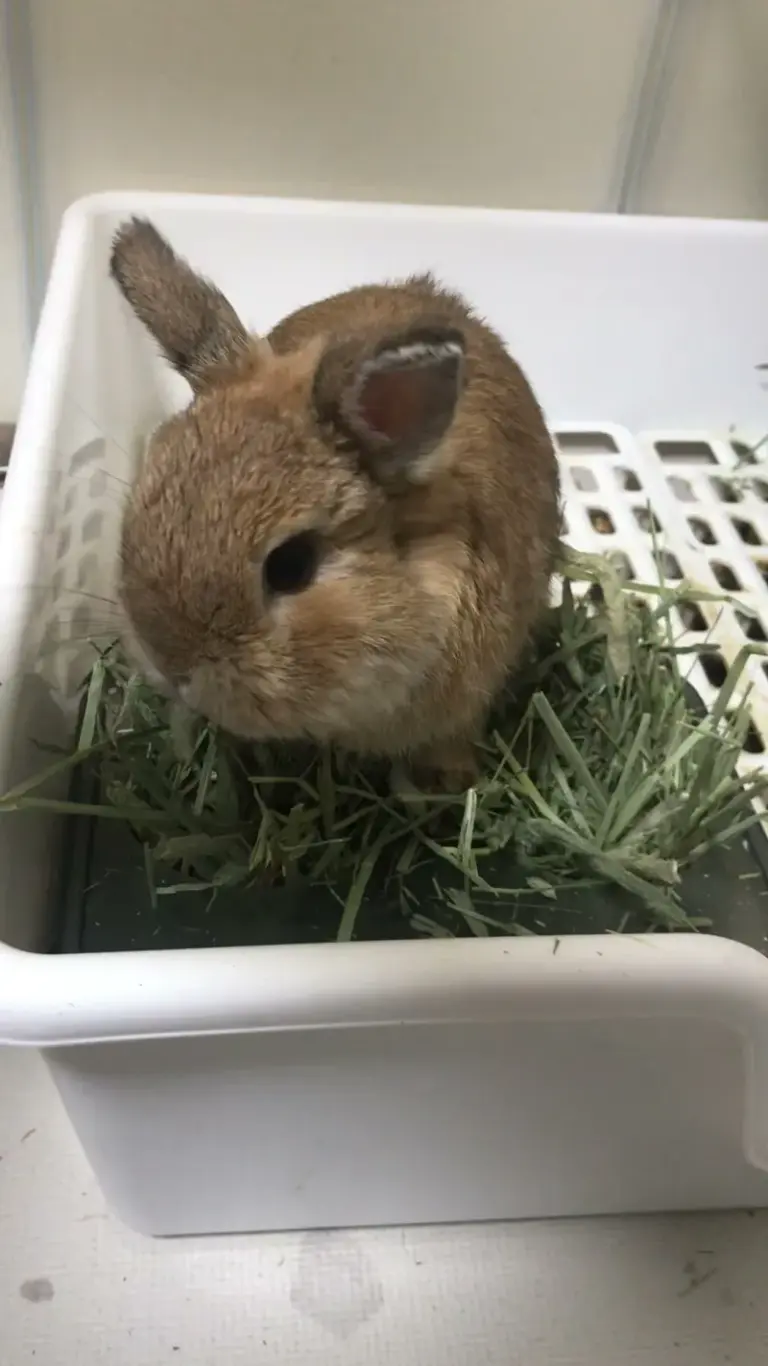
So how do you keep ever-growing teeth at a healthy length? You keep them wearing down. And the way a rabbit wears his teeth down is the most boring answer imaginable: chewing hay, hours a day, every day.
The vet’s feeding advice followed directly from the teeth: pellets in small amounts are fine, but the overwhelming majority of the diet should be hay. He went further — in his long experience, rabbits fed only hay often turn out to be the healthiest ones. I still feed a small measured amount of pellets, so I haven’t gone that far. But it completely reframed what hay is for. I used to think of hay as food and everything else as extras. Now I think of hay as food and toothbrush and gym, all in one, and everything else as negotiable.
Merck backs the direction: a high-fiber diet is protective, and — this genuinely surprised me — a pelleted diet may itself predispose a rabbit to dental disease. Pellets are soft and dense; a rabbit crushes them in a few chews. Hay has to be ground, side to side, stem after stem. All that grinding is the wearing action that keeps the teeth at the right length. A rabbit eating mostly pellets is skipping his own dental care without anyone noticing.
If you want the full picture of how I feed hay — which hay, how much, and the feeder saga — that’s its own post. The short version for this one: unlimited timothy hay, always available, and treated as the non-negotiable center of the diet. His teeth have been maintaining themselves on it for two years.
My daily dental check: the ten-second lip lift
The other habit that came out of that consult costs me nothing, because I’d be doing half of it anyway. My rabbit loves having his head and chin stroked. Several times a day — three or four, honestly, because he demands it — a petting session ends up at his chin, and when it does, he tilts his head slightly back. That’s my opening: I gently lift his upper or lower lip with a fingertip and glance at the front teeth.

Ten seconds, maybe less. What I’m looking for is simple: incisors that meet evenly, sit straight, look the usual length, and keep their usual color — in his case a pale yellow, which is what they’ve looked like through two problem-free years. No visible chips, nothing overgrown, nothing crossing. I’m not diagnosing anything; I’m just watching for change from his normal. If those front teeth ever started drifting from what I see every day, I’d know within a day or two, not months later at a checkup.

Two honest limits to this routine. First, it only works because he’s completely relaxed being handled this way — if your rabbit isn’t there yet, that trust is its own project (a long one, in our case). Second, the lip lift only shows the incisors. The cheek teeth — where diet-related overgrowth actually happens — are far back in a rabbit’s small mouth, and no owner can see them at home. Checking those takes a vet with proper instruments, which is why, when we’re at the clinic for a checkup anyway, I ask the vet to look at his teeth — including the ones I’ll never see. My daily check is an early-warning system, not an exam.
What about chew sticks and dental toys?
Pet stores sell a whole shelf of chew products “for healthy rabbit teeth” — wood sticks, mineral blocks, gnawing toys. My results were underwhelming: I bought apple wood chew sticks, the most recommended item in the category, and my rabbit nudged them a few times and never touched them again. I didn’t buy more. My conclusion wasn’t “find a better chew stick” — it was the vet’s point all over again: the tooth wear is hay’s job. A rabbit doing his hours of daily hay grinding doesn’t need a wooden accessory to keep his teeth in shape. Chew toys are enrichment, nice if your rabbit likes them; mine voted no, and his teeth are fine.
One clarification while I’m here: his single daily treat is a piece of freeze-dried sugarcane, and despite being literally a piece of cane he chews up, I don’t count it as dental care. It’s candy. It gets crunched and swallowed in seconds — it’s not doing the slow lateral grinding that hay does.
The irony is that a rabbit will happily give himself dental workouts you never asked for. Everything in my home gets explored teeth-first — this is the animal that chewed through charger cables, stripped the coating off a steel mat, and bashed a plastic treat dispenser hard enough that I retired it for the sake of those same teeth. A rabbit’s urge to chew is constant. The whole game of rabbit dental care is making sure the thing he chews most is hay.
Warning signs I watch for
From Merck’s list and the vet’s, the signals that would send us to the clinic — none of which I’ve seen in two years:
- Drooling or a wet chin (the classic sign — old rabbit books call it “slobbers”).
- Eating less, eating slowly, or dropping food — a rabbit whose mouth hurts fumbles his hay before he refuses it. Appetite loss in a rabbit is always urgent, because it can spiral into GI stasis within a day.
- Fewer or smaller droppings — the litter box often reports a chewing problem before the mouth does.
- Loud tooth grinding. This one has a twin that means the opposite: the soft, light grinding rabbits do when they’re content — tooth purring, which mine does almost every time I stroke his head. Soft and quiet is a happy rabbit. Loud, harsh grinding is a rabbit in pain. Once you’ve heard the happy version daily, you’d recognize the wrong version instantly.
- Eye symptoms — tearing, discharge, or a bulging eye. Counterintuitive, but per Merck, eye trouble in a rabbit warrants a dental exam.
Two years, zero dental problems
Like a few other posts on this blog, this one describes a problem my rabbit has never had. He’s two years in with straight, even incisors, no drooling, no slow-downs at the hay feeder, and a tooth-purring habit that suggests he’s rather pleased with the arrangement. I don’t get credit for that — the hay does the work, and a vet I’ll always be grateful to told me, unprompted and two hours deep into a neutering consult, why it matters.
Healthy rabbit teeth aren’t a product you buy or a procedure you schedule. They’re a side effect of feeding a rabbit the way rabbits are built to eat. Keep the hay unlimited, glance at the front teeth while you’re petting that chin anyway, and know the warning signs. That’s the whole routine.