Every evening, about half an hour before eight, my rabbit starts getting busy. He does laps. He checks the feeder. He rearranges his real estate. At exactly 8 p.m., his automatic feeder drops his pellets — and he is always, somehow, already waiting. He can’t read a clock. I have no idea how he knows. But he knows.
That little routine taught me the most useful thing I’ve learned in two years of living with a rabbit: almost nothing a rabbit does is random. The zoomies, the circling, the nose bonks, the mysterious furniture rearrangement — it’s all signal. This post is my field guide to those signals, from one very closely observed dwarf rabbit, cross-checked against what veterinarians and rabbit organizations actually say.
First, a quick traffic sign
I’ve already written a whole post about rabbit body language — the ear positions, the flops, the thumps, the tooth purring. That post covers postures and signals: what his body is saying in a given moment. This one covers habits and events: the things he does, the routines he keeps, and what they mean. If you came here trying to decode a specific pose, start there. If you’re wondering why your rabbit just sprinted three laps around the room at full speed, keep reading.
The daily rhythm: lazy days, busy evenings
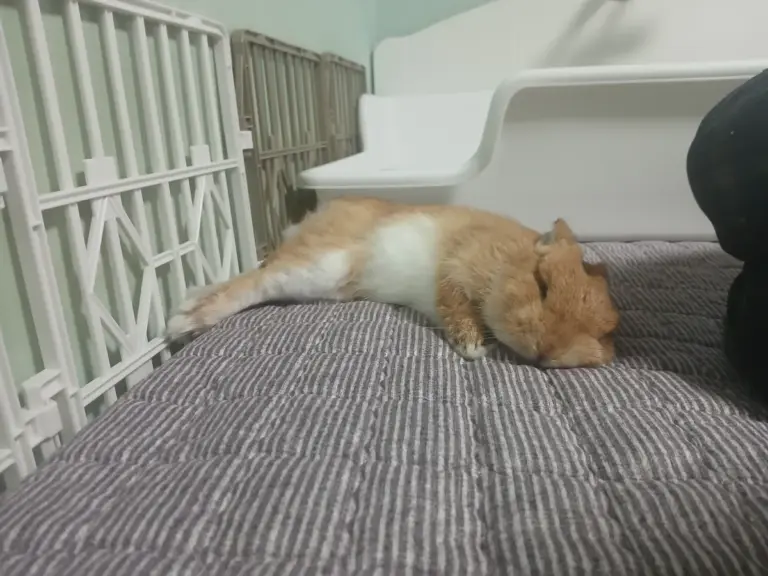
During the day, my rabbit is a decorative object. He naps, he loafs, he occasionally relocates to nap somewhere else. Then evening arrives and someone flips a switch: laps, exploration, demands for attention, general business.
Turns out this isn’t personality — it’s biology. Rabbits are crepuscular, which the Rabbit Welfare Association & Fund describes plainly: they’re most active at dawn and dusk. Long daytime naps aren’t laziness; they’re the factory setting. Once I understood that, I stopped trying to play with him at 2 p.m. (polite tolerance at best) and moved our play sessions to the evening, when he’s actually awake for them. It’s a core part of my daily routine now: his schedule wins, because his schedule isn’t negotiable. The sleep half of that schedule — eyes open, ears down, naps in short bursts — gets its own post: how rabbits actually sleep.
And the feeder thing? His pellets drop at 8 a.m. and 8 p.m., and the pre-dinner activity spike starts like clockwork about thirty minutes early. I genuinely don’t know what he’s reading — light, routine, some internal rabbit chronometer — but two years in, he has never once been surprised by dinner.
Zoomies and binkies: the happy stuff
If you’re new to rabbits, two terms worth knowing. Zoomies: sudden, flat-out sprinting, usually in laps, apropos of nothing. Binky: a jump with a mid-air twist or kick, like the rabbit briefly forgot how gravity works. PetMD’s veterinarian-written body language guide files both under the same heading: a very happy rabbit with energy to burn.
My rabbit’s zoomies peaked around his first year — back then they were a regular show. These days he’s more of a dignified adult: I catch maybe three or four zoomie sessions a week, though I’d bet he runs more that I simply don’t see. The frequency dropped with age, and nothing else changed — appetite, litter habits, affection all normal — so I read it as maturing, not fading. (If activity drops along with eating or litter habits, that’s a different story — see the hiding section below.)
The binkies, though, we’ve turned into a game. I tickle his butt — “tickle tickle” — and he takes off running. Then he comes back. I do it again, and somewhere around the second or third lap the run turns into a binky: the jump, the twist, the whole celebration. A rabbit that keeps returning to the thing he’s “escaping” from isn’t escaping. He invented the game; I just play my part in it.
Circling my feet and bonking my ankles
Here’s the one that confused me longest. When I step into his enclosure, he orbits me — tight circles around my feet, punctuated with little nose bonks against my ankles. It’s not a new act, either: back in his free-roam days, he’d seek me out wherever I was in the room and run the same orbit. The venue changed; the ritual didn’t.
It turns out this is textbook. The House Rabbit Society’s classic “Rabbitspeake” guide covers it directly: neutered males and spayed females may still court — circling each other, or your feet — and the behavior doubles as a way to solicit food and attention. So my neutered rabbit circling my legs is part leftover courtship ritual, part “you have hands and I have demands.” The nose bonks carry the same message — PetMD and the HRS agree that a nudge means notice me. (Fair warning from the same sources: a nudge can also mean “that’s enough petting, thanks.” Context does the talking.)
I’ll be honest: being courted by a rabbit is one of the better parts of my day.
The head under my hand

The politest behavior in his repertoire: if I hold my hand out near him, he walks over and pushes his head underneath it. Not subtle, not ambiguous — a direct petting request, self-service edition. I comply. This is not a negotiation I have ever won, or wanted to.
The flip side runs through the same channel: if petting goes on too long, he doesn’t bite or growl — he starts digging at whatever is under him, which in his dialect means “we’re done here.” I covered that one, and how I respond to it, in the body language post.
The interior designer
Two or three times a week, I find his hay feeder — the one that lives over his litter station — shoved somewhere new. Not knocked over in frustration. Relocated. Deliberately, as far as I can tell, and always to a spot that apparently suits him better than the one I chose.
Rabbits push and toss and rearrange things with their mouths, and some of it is play, some of it is preference, and some of it is possibly just because they can. Mine limits his renovations to the hay feeder — there’s nothing else loose in his enclosure to redecorate with, partly by design (see: the great cable purge). I’ve stopped moving it back. He clearly has opinions, and it’s his house.
New things: sniff first, befriend later
When a new toy enters the enclosure, there’s a protocol. Step one: approach and sniff, thoroughly. Step two — sometimes minutes later, sometimes days — licking, nibbling, and full-contact play. The toys that survive this audition get incorporated into the rotation; mouthing everything is just how a rabbit with ever-growing teeth shakes hands.
What I’ve never seen from him: fear of new objects. No thumping at them, no refusing to enter the area. Curiosity wins every time. I credit some of that to the fact that new things arrive slowly and one at a time in his world — nothing has ever ambushed him.
The “angry rabbit” behaviors mine has never shown
Search results are full of “rabbit angry behavior” and “abnormal rabbit behavior” worries, so for calibration, here’s the complete list of aggressive behaviors I’ve seen in two years — through a cage era, a free-roam year, and the current enclosure:
None. No growling. No lunging. No boxing with the front paws. No biting, ever — at least not at people. (The one theatrical exception: wave his carrot plush at him like a snake and you get a growl and a flurry of paw-boxing. It’s a game with a toy, and it’s covered with every other noise he makes in the rabbit sounds guide.) His entire displeasure vocabulary is the mid-petting dig and the occasional thump at a suspicious noise. Chinning — rubbing scent glands on objects to claim them — is another one I’ve simply never caught him doing.
I’m not saying rabbits don’t do those things; plenty do, and growling or lunging in a previously calm rabbit is worth taking seriously (pain and hormones are the usual suspects — and it’s one reason neutering gets recommended so consistently). I’m saying an “angry rabbit” isn’t the default. A rabbit with territory he trusts, a predictable routine, and nothing competing for his space may just… never need the angry vocabulary.
Hiding: when it’s cozy, when it’s a warning
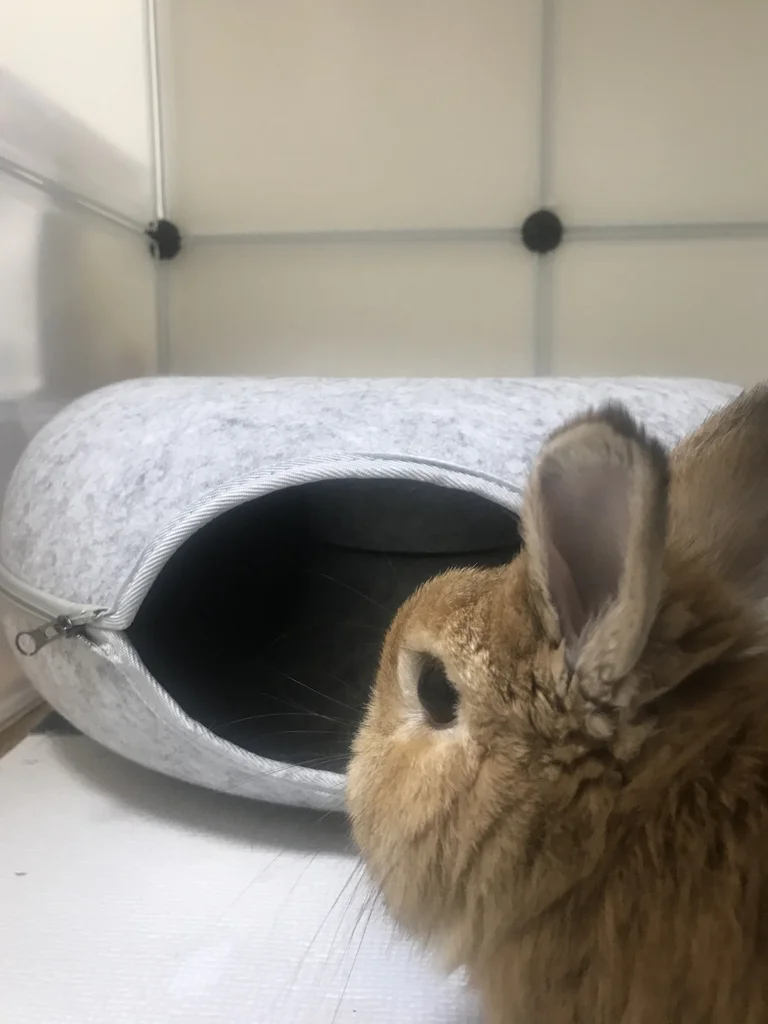
My rabbit has a felt donut-shaped hideout, and he uses it two ways. Mode one: everyday napping headquarters — he flops in it for pleasure, in plain view, completely relaxed. Mode two: shelter. When the neighbors get loud, he retreats into it until the world calms down. Both are healthy; a prey animal having a bolt-hole he trusts is the system working as intended.
The version that should get your attention is different: hiding more than usual. The PDSA lists hiding away and being quieter than usual among the signs of a stressed, sick, or in-pain rabbit — rabbits mask illness for as long as they can, so a behavior change is often the first visible symptom. My rule of thumb: hiding as a location is fine; hiding as a change is a red flag. A rabbit that suddenly lives in the hideout, skips meals, or goes quiet gets checked — starting with the GI stasis warning signs, because with rabbits, that’s the emergency you rule out first.
The bottom line
Two years of watching one rabbit boils down to this: behavior is the interface. The zoomies and binkies tell me the energy budget is full. The circling and the head-under-hand tell me the relationship account is full. The feeder countdown tells me his internal clock is running. And any sudden change in those patterns — less running, more hiding, new aggression — would tell me something is wrong, probably before anything else did.
You don’t need to memorize a behavior dictionary. Watch your own rabbit for a few weeks and he’ll write you a personalized one. Mine did — it’s this post, and the routine built around it.
FAQ
Why does my rabbit circle my feet?
Per the House Rabbit Society, circling is courtship behavior that persists even in neutered and spayed rabbits, and it’s also used to ask for food and attention. In an unneutered rabbit — especially with honking, mounting, or spraying alongside it — it’s more strongly hormonal. In my neutered rabbit, it’s a greeting-slash-demand, and it reliably means I’m about to be lobbied for something.
Are rabbit zoomies normal?
Not just normal — desirable. Veterinary sources describe zoomies and binkies as the behavior of a happy rabbit with energy to spare. Mine did them constantly around age one and now settles for a few sessions a week, which tracked with age, not with any health change. The time to pay attention is when the zoomies disappear together with appetite or litter habits.
What does angry rabbit behavior look like?
Growling, lunging, boxing with front paws, and biting are the classic set. Mine has shown none of them in two years — his complaints top out at digging when petting overstays its welcome. If a previously calm rabbit turns aggressive, don’t write it off as personality: pain and hormones are common drivers, and a vet visit is the right first move.
My rabbit is hiding a lot. Should I worry?
Depends on what changed. Regular napping and retreating in a favorite hideout is healthy prey-animal behavior. Hiding more than usual — especially with reduced eating, smaller or fewer droppings, or unusual quietness — is on the PDSA’s list of illness and stress signals, and rabbits hide problems until they can’t. When in doubt, check the GI stasis warning signs and call your vet; with rabbits, a quiet emergency is still an emergency.