Here is a full inventory of every sound my rabbit has made in two years and four months: a faint “coo-coo” I have to lean in to hear, a soft grinding of teeth when I pet his head, one growl reserved exclusively for a carrot plush, the occasional foot thump, and a stainless steel bowl hitting the floor. That last one is not even a vocal sound. That is the whole list.
If you searched “rabbit sounds” expecting a zoo of noises, that inventory might look disappointing — or worrying, if your own rabbit is just as quiet. So let me put the reassuring part first: a quiet rabbit is a normal rabbit. The PDSA puts it plainly: “Rabbits don’t tend to make much noise and when they do it’s a sign they’re feeling very threatened.” The loud sounds are the exceptions. The quiet ones — and the silence itself — are where most of the meaning lives.
Why rabbits are so quiet in the first place
Rabbits are prey animals. Out in a field, the rabbit that narrates its feelings is the rabbit that gets found. So instead of barking or meowing their way through the day, rabbits run most of their communication through posture — ears, body position, flops, thumps. That is why I wrote a whole guide to rabbit body language before this one: with rabbits, the body does the talking and the voice is a footnote.
But the footnote exists, and once you learn it, the few sounds a rabbit does make become surprisingly easy to read. Here is every one I have actually heard, in rough order of how often I hear it — followed by the ones I have never heard, which are honestly the more important ones to know.
The soft “coo-coo”: honking and clucking
The first real vocalization I ever noticed took months to catch, because it is genuinely quiet — I only hear it with my ear close. Every so often while I am petting him, he makes a faint, rhythmic “coo-coo, coo-coo,” almost like a tiny pigeon. He also does it sometimes while working through his hay.
Rabbit literature files these little sounds under two names. The House Rabbit Society’s classic Rabbitspeake glossary describes soft honking or oinking as “a love song, also used to solicit food and attention,” and clucking as the faint sound of “a bunny who has been given a particularly tasty snack” — their translation: “Yum, yum!” Which one is mine making? Honestly, I cannot always tell where honking ends and clucking begins. The petting version reads like the love-song one; the hay version is presumably the yum-yum one. Either way, both sit firmly in the happy column, and both are so quiet that plenty of owners probably never notice their rabbit does it at all.
Purring: the quiet tooth grind that means all is well

This is the most dependable sound in the house. When I pet his head, he almost always responds with a soft, light chattering of his teeth — rabbit purring. It is not a cat’s engine-rumble; the HRS describes it as “a series of fast but light vibrations of the teeth,” and that is exactly what it sounds like up close: a faint, contented clicking.
If you want one sound to learn from this whole article, make it this one, because it doubles as a health baseline. Quiet, light tooth purring during petting means a relaxed rabbit. The same instrument played differently — a loud, slow, crunching grind — means the opposite, and I will get to that in the never-heard section below. The difference matters enough that it comes up in both my rabbit teeth guide and the emergency signs list in my GI stasis post.
Growling: the carrot plush incident(s)
In two years, my rabbit has never once growled, grunted, or lunged at a person. I wrote in my behavior guide that I have simply never seen aggression from him, and that still holds. But I know exactly what his growl sounds like — because of a carrot.
He owns a carrot plush he genuinely likes. But if I hold it and wiggle it toward him like a snake, the reaction flips: a low “grrr-rumble” and a lightning flurry of front-paw strikes — bap-bap-bap — until the offending carrot retreats. The HRS glossary maps this exactly: snorting and growling express anger and may precede a “grunt-lunge-bite directed at an adversary.” Mine has never taken it to the bite stage; the paw boxing settles the matter. The takeaway if your rabbit growls at you: it is not random noise. It is a clear “back off” warning, and the polite response is to respect it before it escalates.
Thumping: the alarm system
The loudest thing his body produces. When a sudden noise startles him, the sequence is always the same: a burst of frantic laps around the space, then he plants in one spot and thumps the floor with his hind legs — a surprisingly loud, hollow “thunk, thunk.”
Thumping is ancient rabbit hardware. The PDSA notes it “would originally have acted as warning to other bunnies nearby that there’s danger about” — a prey animal’s air-raid siren. There are no other rabbits here to warn, but the siren fires anyway. What I have found is that it is also a request for an all-clear: if I walk over and pet him calmly, the thumping stops and he settles. I read that as the colony equivalent of “false alarm, stand down.” There is more on thumping in the body language guide, because it is as much a posture as a sound.
The protest breathing
One more sound, and an honest edge case. He tolerates being held, but not indefinitely — and nail trims require “indefinitely” by his standards. Hold him past his patience budget and his breathing turns audibly rough and huffy. The HRS glossary actually has a word for this register: wheezing sniffs that “combine vocalizations with nasal sounds to ‘voice’ a protest.” That is precisely the energy — less “medical event,” more “formal complaint.”
The important caveat: protest huffing happens during restraint and stops the moment he is released. Noisy or labored breathing in a rabbit at rest is a different thing entirely — that is vet territory, not blog territory. If your rabbit sounds effortful just breathing, treat it as urgent and call your vet.
The sounds I have never heard — and hope I never do
Two years, four months. Never once:
- Screaming. Rabbits can scream — a high, awful sound reserved, per the PDSA, for extreme cases when a rabbit feels severely threatened, panicked, or in pain. Zero occurrences here, which is exactly the count you want. If you ever hear it, go to your rabbit immediately and involve a vet if anything seems off.
- Loud teeth grinding. The evil twin of purring. The HRS describes it as “a louder, slower grind” that signals sickness or discomfort — it is one of the classic pain tells in rabbits, and one of the signs I watch for in the context of GI stasis. Quiet fast grind while being petted: good. Loud slow grind while hunched alone: vet.
- Sneezing. Not a single sneeze that I have personally heard in two years. I only note it because repeated sneezing or snuffly breathing in rabbits is worth a vet conversation — it is just a chapter I have no experience with, so it stays a bullet point.
This list is the real reason to learn rabbit sounds. The happy noises are trivia; the alarm noises are actionable. A mostly silent rabbit is not a communication failure — it means the sounds that do break the silence deserve your attention.
The loudest sound in the house is not vocal
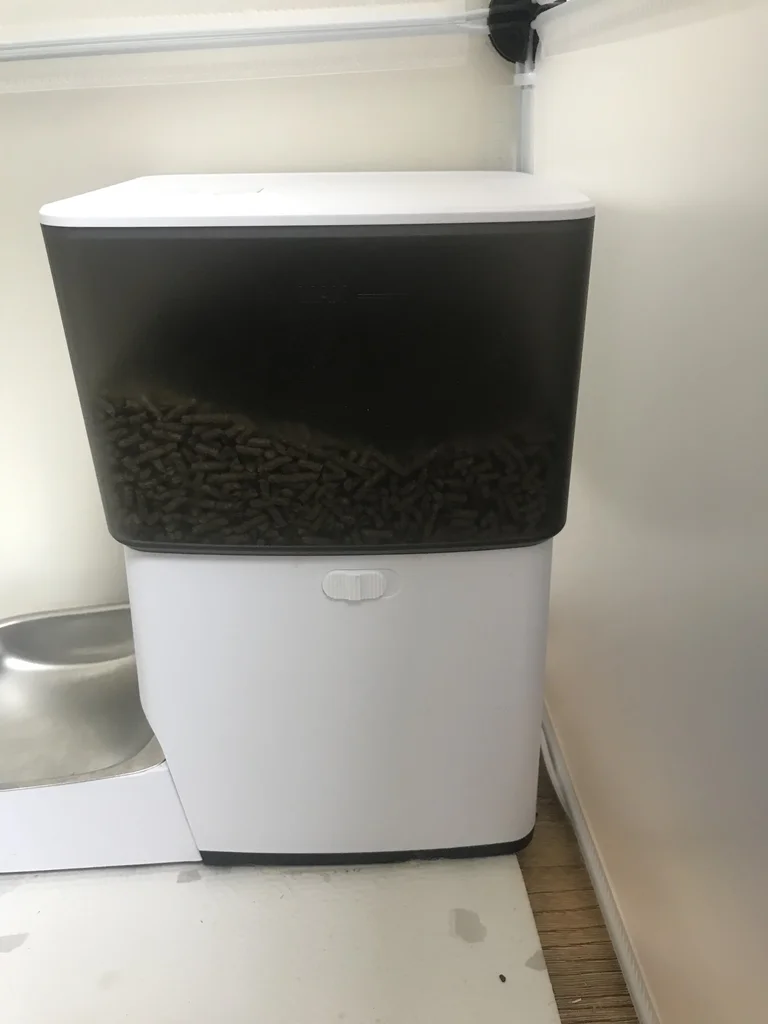
Ask me what rabbit sound I actually hear most and the answer is none of the above. It is a stainless steel bowl hitting the floor. His pellet feeder has a removable steel bowl, and every so often he grips it with his teeth and flings it — a clean, ringing “clang” that carries through the entire apartment. I put it back. We do not discuss it. (Rabbits picking things up and tossing them is normal object play; mine has simply chosen percussion.)
Add the daily rustle-and-shove of him rearranging his hay while he eats, and you have the complete FluffTrail soundscape. If you are wondering about rabbits and nighttime noise: rabbits are crepuscular — most active around dawn and dusk, as covered in the behavior guide — so what most owners report as “night noise” is usually this kind of object percussion during evening activity hours, not vocalization. Ours quiets down with the household.
And the traffic runs both ways: sounds we make barely register anymore. The vacuum sent him running as a baby; these days it gets an ear-swivel at most. Rabbits habituate to household noise remarkably well — part of the general settling I describe in how we run daily care.
FAQ
What sounds do rabbits make?
Very few, very quietly. The common ones: soft honking/oinking and clucking (contentment, food, attention), tooth purring (relaxation), growling or grunting (a back-off warning), and thumping (alarm). Loud sounds — screaming, loud tooth grinding — are rare and signal distress or pain.
Why is my rabbit honking?
Soft honking is a happy, excited sound — the House Rabbit Society calls it “a love song, also used to solicit food and attention.” It is especially common in unneutered rabbits during courting, but neutered rabbits honk too, usually about food or their favorite person.
What does it mean when a rabbit screams?
Extreme fear or pain — it is rare and always serious. Veterinary sources treat screaming as a sign a rabbit feels gravely threatened. Check on your rabbit immediately, and if there is any sign of injury or illness, contact a vet urgently.
Do rabbits make noise at night?
Rarely with their voice. Rabbits are crepuscular (most active at dawn and dusk), so nighttime “noise” is usually activity sounds — digging, rearranging hay, tossing bowls, rattling an enclosure — rather than vocalization. A rabbit that suddenly becomes vocal at night is worth checking on.