My rabbit turned two years and four months old this summer. When I mention that to people, most assume he is somewhere in rabbit middle age. He is not even close. Statistically, a well-kept indoor rabbit at two is just wrapping up the first quarter of his life — which surprises almost everyone who did not grow up around rabbits, including me when I first looked it up.
So here is the answer up front, and then the longer version from someone actually living through the timeline: how long rabbits live, why the pet number and the wild number are so different, what changes as they age, and — the part I care about most — what seems to actually decide whether a rabbit reaches the far end of the range.
The short answer: 8 to 12 years for a pet rabbit
According to PetMD, a domesticated rabbit typically lives between 8 and 12 years. Some make it further — the Guinness World Records holder for oldest rabbit ever, an Australian rabbit named Flopsy, lived 18 years and 10 months.
Wild rabbits are a different story entirely: the same PetMD article puts their average at just 1 to 2 years. Predators, weather, disease, scarce food — the outdoors is brutally efficient at shortening that number. It is worth keeping in mind whenever you see a low figure quoted somewhere: the question “how long do rabbits live” has two honest answers, and the one that applies to the rabbit in your living room is the long one. A pet rabbit is a genuine decade-scale commitment, closer to a dog than to a hamster.
Lifespan by breed: smaller tends to mean longer
With rabbits, the size rule runs opposite to what dog owners expect: smaller breeds generally outlive larger ones. Here is what PetMD lists for a few of the popular small breeds:
| Breed | Typical lifespan |
|---|---|
| Netherland Dwarf | 10–12 years |
| Mini Lop | 8–10 years |
| Lionhead | 7–9 years |
Mine is a Netherland Dwarf — a show-quality one, according to the breeder, though he has never had to prove it professionally. On paper that gives him one of the longest runways a rabbit can have: 10 to 12 years. Which means that at two and a bit, the math I opened with holds up. He is a young adult, nowhere near the halfway mark.
Take the breed numbers as tendencies, not guarantees. Every source I checked puts more weight on care — diet, housing, vet access — than on breed. A well-kept Lionhead will outlive a neglected Netherland Dwarf without breaking a sweat.
Two years and four months in: what aging actually looks like
I brought him home on May 31, 2024, at about one month old. He was a fist-sized ball of scruff that mostly hid behind the hay box. Two years later, I will just say it: the glow-up was real. The scrawny baby fuzz gave way to a dense, even adult coat, the head caught up with the ears, and somewhere around his first birthday he went from “generic small creature” to an actual handsome rabbit. I did not expect to have opinions about rabbit looks. I do now.
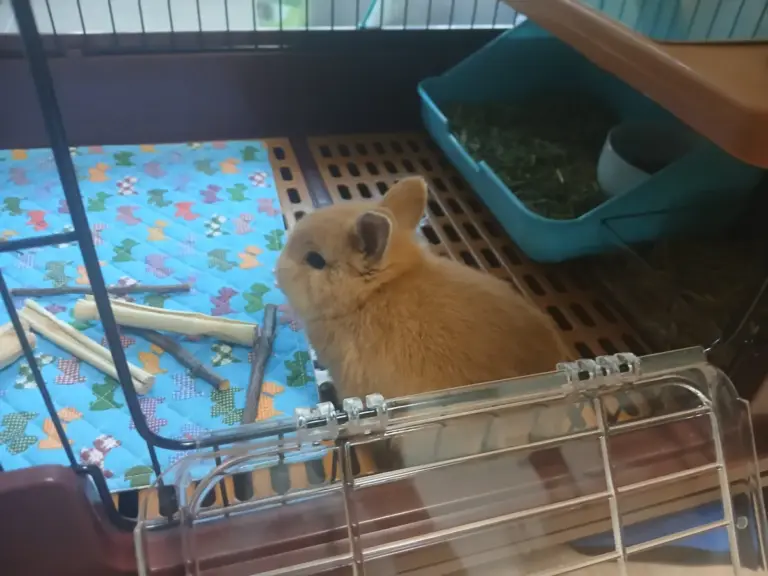
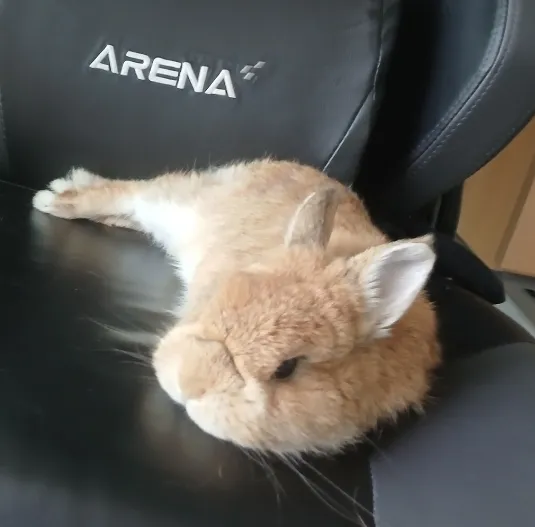
Beyond looks, two changes marked the shift from baby to adult in this house:
- The hay switch. As a baby he ate alfalfa hay; as he matured we moved him to unlimited timothy hay, which is the adult standard — alfalfa is too rich for a grown rabbit to live on. That transition is part of every rabbit’s timeline, and it is covered in his complete diet breakdown.
- The energy settling. Around age one he was at his rowdiest. Now he is calmer — still does his zoomie laps a few times a week, but the constant baby chaos has mellowed into a routine. From what I have read this is a normal arc, not a decline; nothing else about his appetite or habits has changed.
What actually cuts rabbit lives short
Here is the part the tidy “8 to 12 years” figure hides. Rabbits rarely die of old age at year three or four — when a rabbit’s life ends early, there is usually a specific, fast-moving reason. And in my small circle, I have seen the most common one up close, secondhand.
A couple of years ago, someone I know lost their rabbit at seven years old. Not to age — to what I was told was an intestinal blockage. Seven years of good care, and the gut still ended the story with years left on the clock. That conversation is a big part of why my guide to GI stasis is the most safety-focused post on this site: a rabbit’s digestive system is the single point of failure. It can go from “ate less dinner” to an emergency in a day or two, at any age, in any breed.
So when I think about my rabbit reaching 10 or 12, I honestly spend very little of that worry on his breed or his genes. The lifespan statistics all quietly assume one thing: that the gut keeps moving, every single day. That is the assumption an owner can actually do something about.
The longevity levers I am actually betting on
Nobody can promise a rabbit a long life. But the things that shift the odds are boringly consistent across every source I have checked, and they happen to be the pillars of how we run things here:
- Hay-first diet, above everything. If I could only keep one habit, it is unlimited hay. It is what keeps the gut — the failure point from the previous section — moving. Everything else in the food bowl is negotiable; the hay is not.
- Indoor housing. The gap between “1 to 2 years wild” and “8 to 12 years as a pet” is mostly environment. Living indoors removes predators, temperature swings, and a good share of disease exposure in one move.
- Knowing a rabbit vet before you need one. He has been to the clinic exactly twice — a consultation first, then the neuter a few weeks later, which came with a full blood panel, all clear. That baseline plus a clinic that knows him is worth more than any supplement. Rabbits hide illness; by the time a problem is visible, you want the vet trip to already be a solved logistics problem, carrier and all.
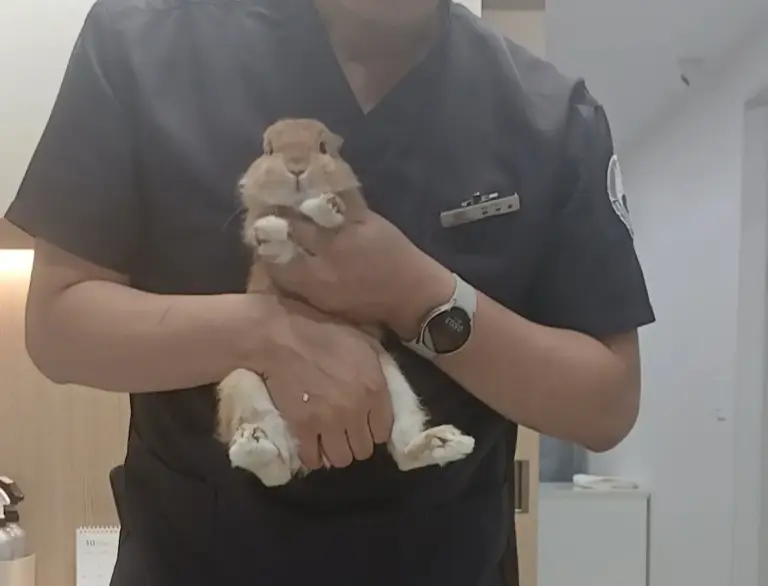
On neutering, an honest split. Mine is a neutered male, and I will not pretend I did it for lifespan — I did it to head off spraying and hormonal behavior, and the lifespan benefit for males is indirect at best. For females, though, the calculus is completely different: veterinary sources report that a large share of unspayed female rabbits — figures commonly cited run from 50 to 80 percent by mid-life — go on to develop uterine adenocarcinoma, a cancer that early spaying essentially prevents. If you have a female rabbit, that is a conversation to have with your vet sooner rather than later.
On vaccines, full transparency. My rabbit is not vaccinated. He lives strictly indoors, never goes on walks, and his only outings are vet visits — and on that risk profile, skipping vaccination was the call I made. I want to be clear that this is a personal judgment, not a recommendation: diseases like RHDV2 are exactly why vaccination guidance exists, and if your rabbit spends any time outdoors, meets other rabbits, or lives where outbreaks occur, that decision belongs in your vet’s office, not in a blog post.
FAQ
How long do rabbits live as pets?
Typically 8 to 12 years for a domesticated rabbit, per PetMD — with diet, housing, and vet care mattering more than breed. Small breeds like the Netherland Dwarf sit at the top of that range at 10 to 12 years.
How long do rabbits live in the wild?
Only 1 to 2 years on average, according to PetMD. Predators, disease, and exposure — not biology — account for the gap. The same animal, kept indoors, can live five times as long.
What is the oldest rabbit ever recorded?
Flopsy, a wild-caught rabbit in Tasmania, Australia, lived 18 years and 10 months — the standing Guinness World Records mark. Anything past 12 is exceptional; past 15 is record territory.
Do neutered rabbits live longer?
For females, the evidence is strong: unspayed females carry a high risk of uterine cancer, so spaying meaningfully protects lifespan — ask your vet about timing. For males, neutering is mostly about behavior and easier bonding; any lifespan effect is indirect.