Two years and change into living with a rabbit, there are still moments when I look over at him and genuinely cannot answer a very basic question: is he asleep right now? He’s lying flat, he’s clearly not doing anything, his eyes are open. Awake rabbits have open eyes. Apparently sleeping rabbits also have open eyes. Thanks for nothing, eyes.
It turns out this is not a me problem — it’s a rabbit feature. Rabbits really do sleep with their eyes open, which means most owners are watching their rabbit sleep far more often than they realize, and missing it. So here’s everything I’ve worked out about how my rabbit sleeps: the eye thing, the ear trick that actually tells you the truth, his two official bedrooms, and the position I can only describe as fried shrimp.
Do rabbits sleep with their eyes open?
Yes — and mine almost never fully closes his. If I had to describe his default sleep mode, it’s this: lying down, eyes open or narrowed to slits, looking for all the world like he’s just zoning out.
The mechanism is a piece of anatomy we don’t have: a third eyelid. As the House Rabbit Society’s guide to the rabbit eye puts it, thanks to their third eyelid, rabbits “can also sleep without fully closing their eyes, essentially sleeping with them open.” The membrane keeps the eye lubricated, so there’s no need to shut the outer lids the way we do. And the reason is pure prey-animal logic — the same guide calls it “a survival tactic”: in the wild, open eyes keep the light receptors active, so a sleeping rabbit can still register an approaching shadow and be gone before the shadow has an opinion about it.
My rabbit has lived indoors his entire life, in a home where the deadliest predator is the vacuum cleaner. His eyes stay open anyway. Two million years of “sleep like something is watching you” doesn’t get switched off by a felt donut house.
The shrimp tempura position
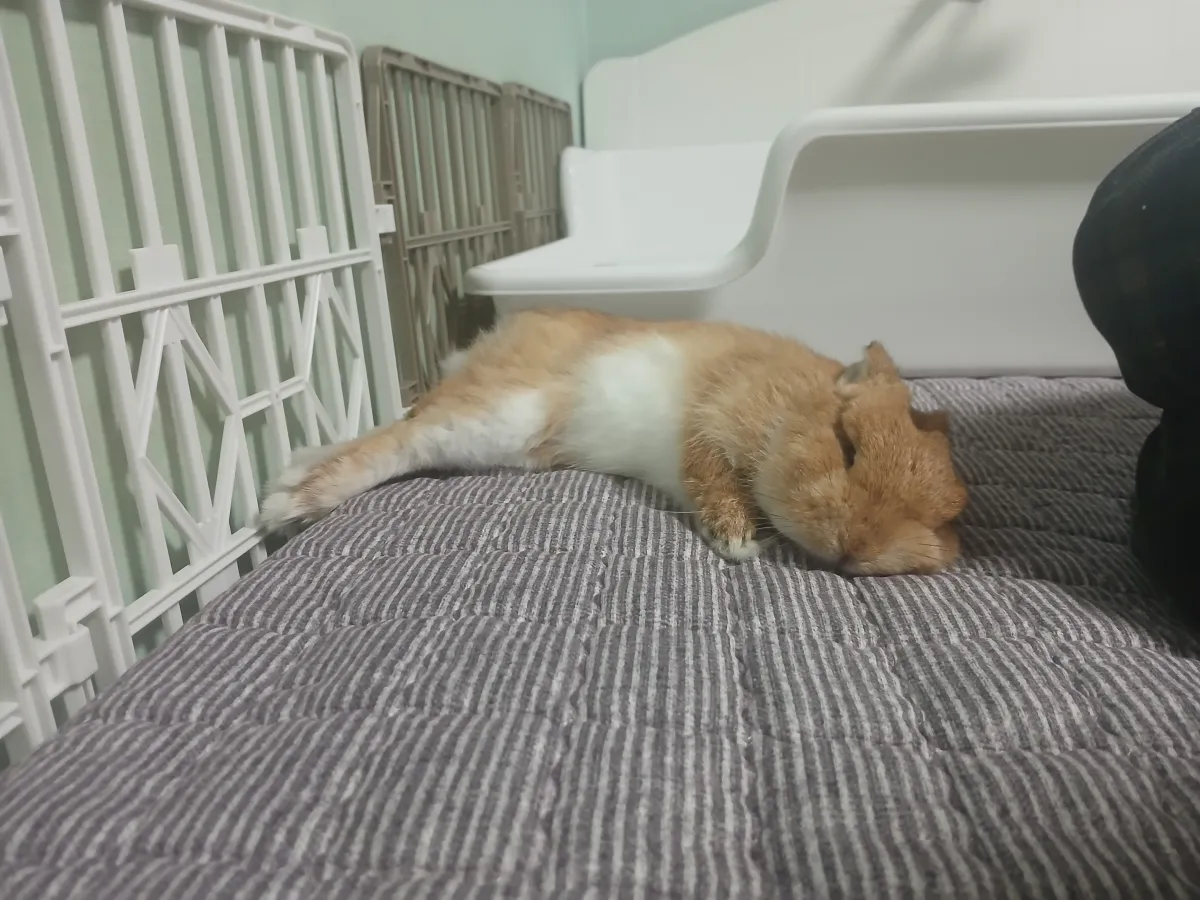
Every rabbit owner ends up inventing names for their rabbit’s sleep positions. Mine sleeps most often in what I privately call the shrimp tempura position: completely flat on his belly, pressed to the floor, with his legs swept out to one side. Body flat, legs tucked along the flank at an angle — the exact silhouette of a fried shrimp. I have never found a better description and I’ve stopped trying.
He also sleeps in the classic loaf — legs folded under, bread-shaped — which surprised me at first, because a loafing rabbit looks alert. And then there’s the famous flop, the dramatic keel-over onto one side that makes new owners think something is wrong. It’s the opposite of wrong: a flopped rabbit is a rabbit that has decided guarding its own body is no longer necessary. (More on what these postures say about a rabbit’s mood in my body language guide.)
How I actually tell he’s asleep: watch the ears, not the eyes
Since the eyes refuse to cooperate, I’ve learned to read sleep somewhere else entirely: the ears.
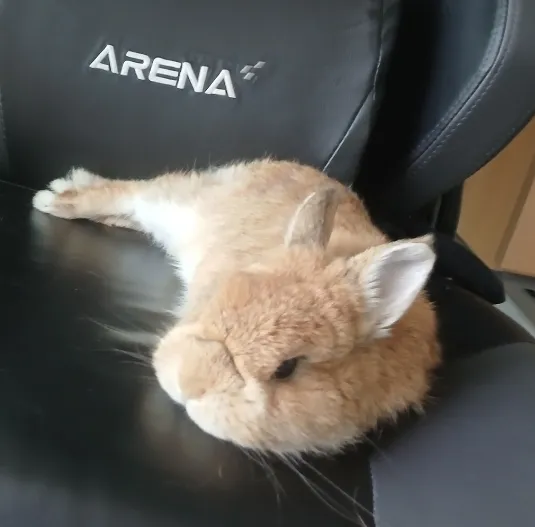
When my rabbit is properly asleep, two things happen together: his ears droop back, completely limp against his body, and his eyes narrow into slits. Ears down plus slit eyes — that combination, in whatever position he’s in, means he’s asleep. It’s the only signal I fully trust.
The wake-up is even more legible. Those limp, drooped ears suddenly snap upright — from flat to vertical in an instant, like antennas deploying. When that happens, there is zero ambiguity: he’s awake, and he’s processing something. The ears are an honest organ. The eyes lie constantly.
And the honest middle ground: if he’s lying there limp with his eyes fully open — no slits, no drooped ears, just… horizontal — I genuinely cannot tell whether he’s asleep or just lying around. After two-plus years I’ve made peace with not knowing. Given that rabbits sleep with their eyes open by design, I suspect the answer is “asleep more often than I think.”
When and how long do rabbits sleep?
Here’s what the literature says, and then what I can actually verify from the sofa.
According to the PDSA, rabbits are neither nocturnal nor diurnal but crepuscular — “most active at twilight,” around sunrise and sunset. Sleep-wise, “most rabbits sleep a total of six to eight hours over 24 hours,” and a relaxed house rabbit might reach ten. But it doesn’t come as one long block: rabbits are polyphasic sleepers, taking lots of short naps through the day and night, dozing “while loafing with half-closed eyes” — which is my rabbit, described by a UK vet charity with unsettling accuracy.
What I can confirm first-hand: he sleeps in short bursts, never long stretches. I’ll catch him ears-down-slit-eyed for a while, then he’s up, rearranging the hay, then he’s down again. What I can’t give you is a full 24-hour sleep log, because I also sleep, and unlike him I do it in one embarrassing eight-hour block with my eyes closed like prey. What he does at 3 a.m. is between him and the ceiling. (His waking schedule and habits are covered in the behavior guide.)
Where he sleeps: two official bedrooms
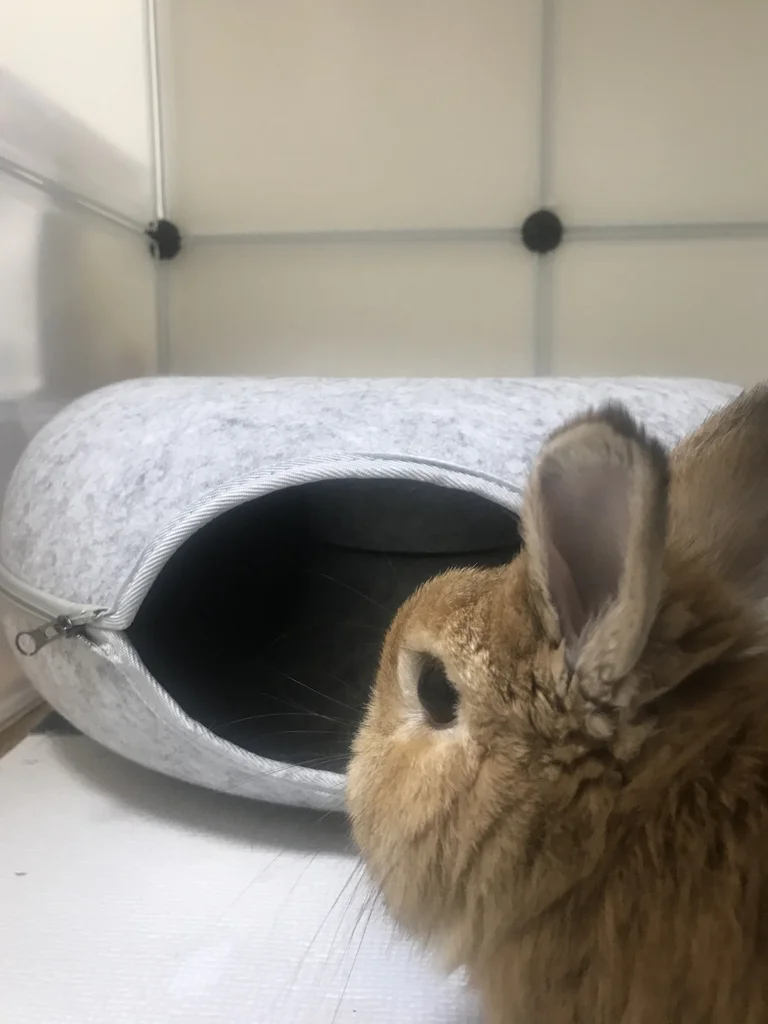
My rabbit has exactly two sleeping spots, and after years of observation I can even give you the market share: the felt donut house, about 60% of the time, and the mat, about 40%. The donut house sits inside his enclosure and is the closest thing he has to a burrow — enclosed, dim, his. The mat naps tend to happen out in the open, often during free-roam time, in the middle of the floor, in full view. That split feels very rabbit to me: half the naps in a bunker, half in the open where he can pretend he wasn’t sleeping at all.
He picked both spots himself. Nobody assigns a rabbit a bedroom; you just eventually notice where the naps keep happening and admit that’s where the bedrooms are.
Asleep, or unwell? The one distinction that matters
One caveat I’d be irresponsible to skip. A sleeping rabbit is relaxed but reboots instantly — ears up, alert, and reliably interested in food. A rabbit that stays limp, ignores your approach, and turns down food is not sleeping deeply; that’s a different situation entirely, and in rabbits it’s an urgent one. If “napping a lot” comes with not eating or shrinking droppings, stop reading sleep articles and check the GI stasis warning signs.
For completeness, the things I’ve never once seen in two-plus years: dream-twitching, sleep-grinding, anything resembling a rabbit nightmare. He sleeps like he does everything else — quietly, efficiently, and with a strong preference for not being perceived.
FAQ
Do rabbits sleep with their eyes open?
Yes. A third eyelid keeps the eye lubricated, so rabbits can sleep without closing their outer lids — the House Rabbit Society describes it as a survival tactic that keeps light receptors active against predators. Mine almost never fully closes his eyes; at most they narrow to slits.
How many hours a day do rabbits sleep?
Per the PDSA, most rabbits total six to eight hours across 24 hours — up to ten for a relaxed house rabbit — taken as many short naps rather than one long sleep.
Are rabbits nocturnal?
No — crepuscular. They’re most active around dawn and dusk and nap through the middle of the day and night. Mine keeps that schedule loosely: short sleep bursts at all hours, never one big block.
How can you tell if a rabbit is sleeping?
Don’t trust the eyes — they stay open. On my rabbit the reliable signal is ears drooped flat and limp, paired with slit eyes, in any position. When the ears snap back upright, he’s awake. If a rabbit is limp and unresponsive and refusing food, that’s not sleep — see a vet.
Sleeping positions are half of rabbit body language — the rest of the dictionary is in my rabbit body language guide.