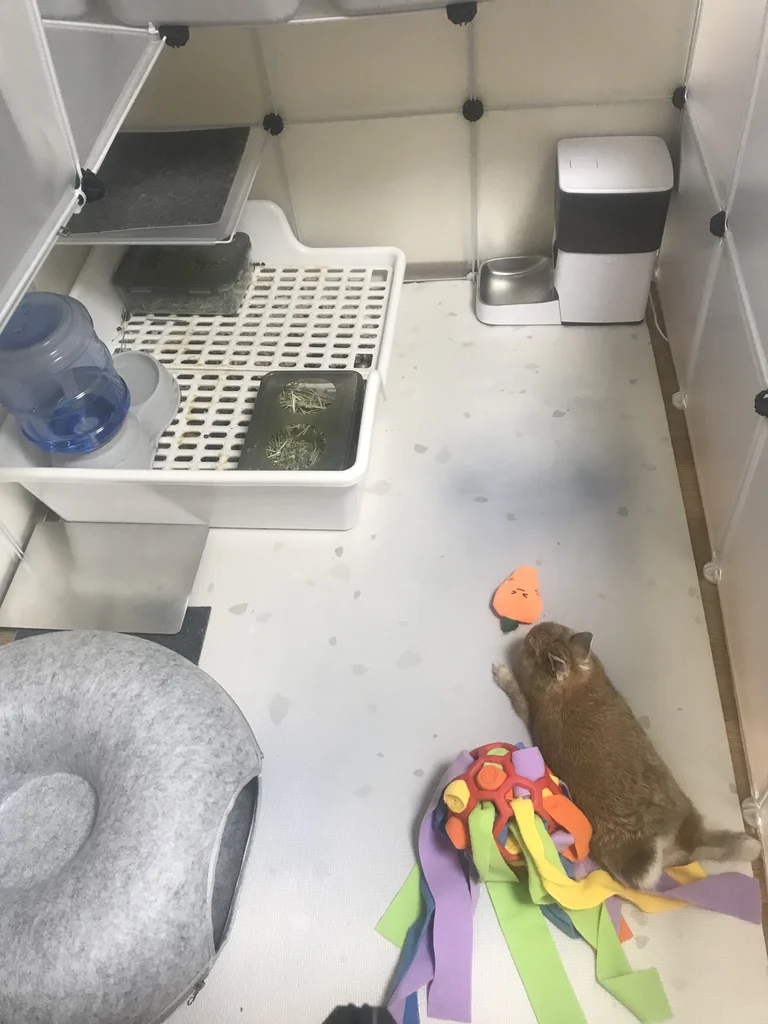
I never once saw my rabbit chew a cable. That’s the part that still gets me. Both times, all I ever found was the aftermath: a cord at floor level, chewed about halfway through, and the only suspect in the room looking perfectly innocent. No witnesses, no confession. But when the only other resident of the room has teeth that never stop growing, the case solves itself.
This is the story of the two cables he killed, the danger I only understood after the fact, and the bunny-proofing approach that has given us zero incidents since. Spoiler: I didn’t buy a single cord protector. I did something more boring and more effective — I made the wires not exist.
Two cables, two repair bills

Both incidents happened during his free-roam year, when the whole room was his territory — cables included.
Victim one: a phone charger cable. Found chewed about halfway through. Not fully severed, which is somehow worse — a half-stripped cable that still carries current is exactly the thing you don’t want lying on the floor at rabbit height. That one was a cheap fix: I threw it out and bought a new one.
Victim two: the internet cable — and this one hit in real time. I was on my PC, mid-game, when the connection suddenly dropped. While I was still doing the confused what-just-happened scan of the room, I spotted him: wedged into the corner where the cables ran, only his butt sticking out. I moved him aside, checked the bundle of wires he’d been parked on, and found one chewed about halfway through — and of the several cables in that corner, he’d picked the internet line. I still never saw the chewing itself. I just got to experience the consequences with zero lag, mid-match. This one I couldn’t fix with a shopping trip; a technician had to come out and run a new line, and explaining why it needed replacing was its own small humiliation.
Individually, neither was expensive. But the pattern was the point: my rabbit wasn’t hypothetically a cable-chewer. He had a track record, and every cable in the room was on the menu.
The part I only learned afterward
At the time, I treated it as a repair-bill problem. Then I started reading, and the mood changed fast.
I came across another rabbit owner’s account of their rabbit biting into a live cable, burning its mouth, and needing veterinary treatment. And the veterinary literature backs that up as the standard outcome, not the rare one: PetMD’s veterinarian-written guide to electric cord bites in rabbits describes burns in and around the mouth — lips, gums, tongue — sometimes with singed fur around the face. Because the current doesn’t stop at the mouth, it lists effects reaching the heart and lungs: breathing trouble, heart rhythm problems, collapse.
The detail that genuinely scared me: it isn’t always obvious right away. PetMD notes that fluid accumulation in the lungs can show up as much as two days after the bite, and the Merck Veterinary Manual treats electrical cord injuries in pets as true emergencies for exactly that reason — a pet that looks fine after chewing a cord isn’t necessarily fine. Veterinarians advise getting any rabbit that may have bitten a live cord checked out, symptoms or no symptoms.
My rabbit walked away from two chewed cables without a scratch. Reading all this made clear that was luck, not skill. A few millimeters deeper on the charger cable and my “repair bill problem” could have been an emergency vet visit — or worse. That realization became one of the reasons his free-roam era ended.
Why rabbits chew wires (it’s not mischief)
It’s worth being fair to the rabbit here: he wasn’t being destructive. He was being a rabbit.
Rabbit teeth grow continuously for life, which makes chewing a biological need, not a hobby. Rabbits also explore the world mouth-first — PetMD compares them to human infants in that respect: if it’s interesting, it goes in the mouth. And cables are, apparently, very interesting. The House Rabbit Society’s rabbit-proofing guide notes that charging cables are so temptingly chewable that rabbit owners have a nickname for them: “white hay.”
Once I read that, the pattern at my place made perfect sense. He ignored furniture, walls, and baseboards entirely — and went straight for the two most cable-shaped things in the room. This wasn’t a behavior problem to train away. It was an environment problem to design away.
My fix: not covers — no wires at all
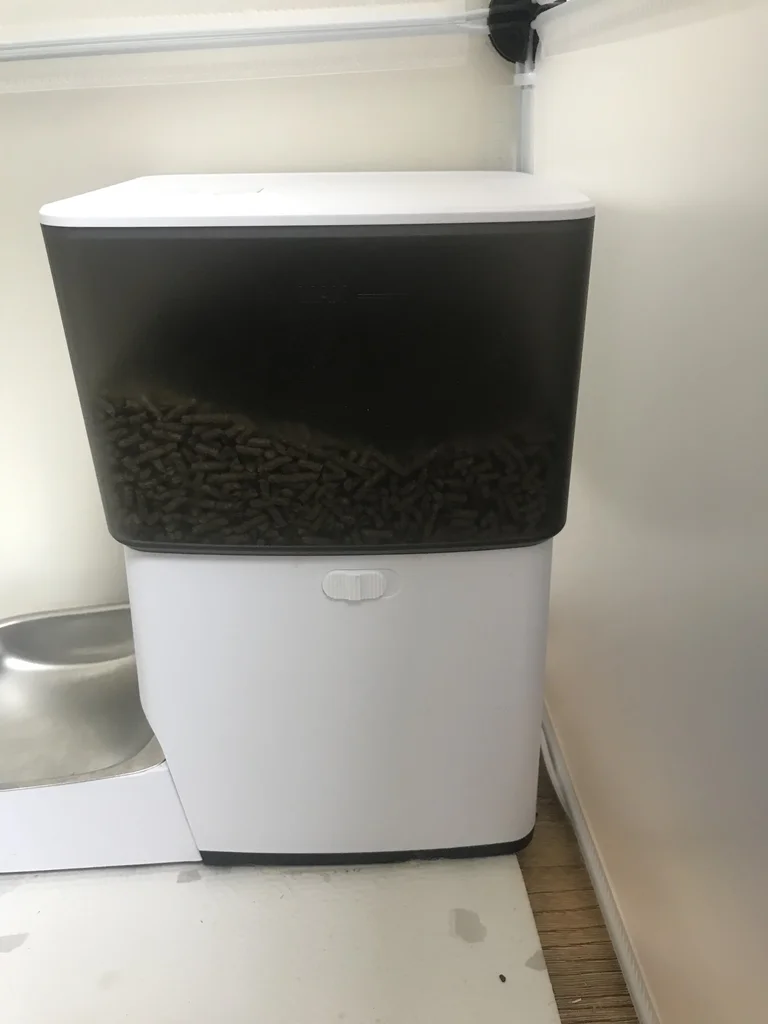
The standard bunny-proofing advice is to armor your cables: split-loom tubing, cord channels, protectors. That works for a lot of people, and I’ll cover it below. But when I rebuilt his living situation around the DIY enclosure, I went a different way:
There are no wires in his space. Zero.
I did a full cable audit of his corner of the room and rerouted, shortened, or relocated everything until his territory contained nothing with a plug. The one appliance that lives in his enclosure — the automatic pellet feeder — has its cable routed straight out past the enclosure wall, so the machine is inside but the wire is outside, beyond the reach of any rabbit tooth. Chargers never get plugged in near his space. That’s the entire system.
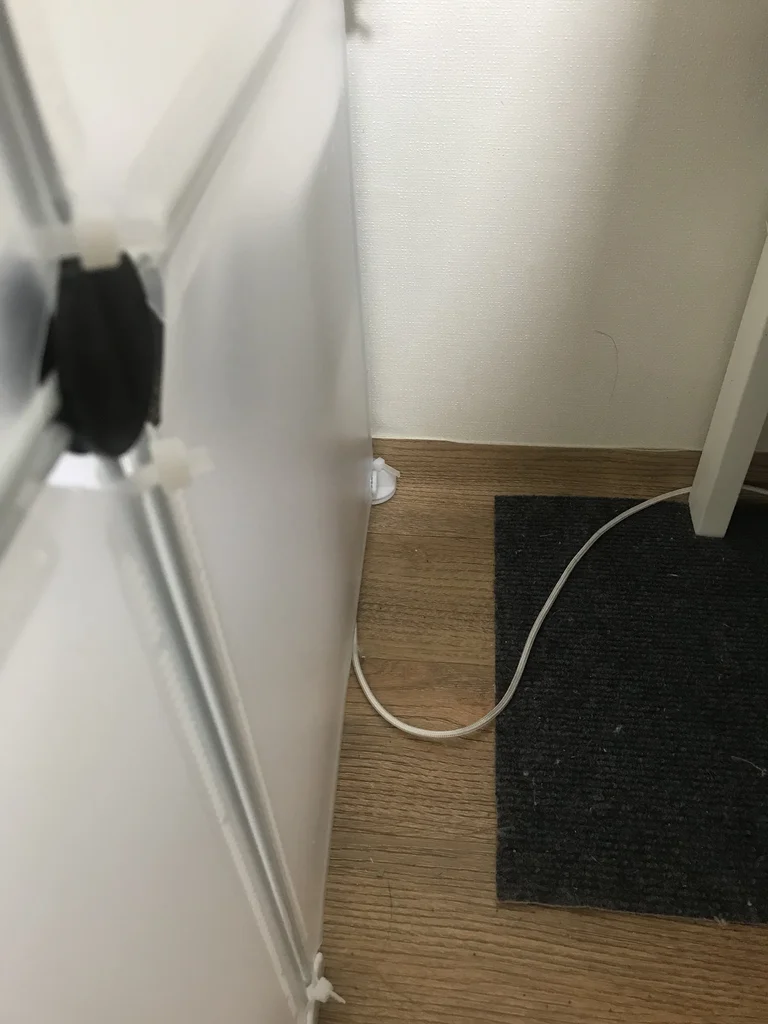
The logic is almost embarrassingly simple: a cord protector can be chewed through, tested, or defeated by a sufficiently motivated rabbit — but a wire that isn’t there can’t be chewed. Protection has a failure mode. Absence doesn’t.
Since the switch: two years, zero chewed cables, zero close calls. Not because he reformed — because there’s nothing to chew.
If you can’t remove a wire
Removal-first is my strong recommendation, but some wires genuinely can’t leave the room. For those, the standard advice is sound — it’s just my second choice, not my first:
- Split-loom tubing. The House Rabbit Society recommends covering unavoidable cables with split-loom or split-wire flexible protectors — the corrugated kind you can find cheaply in hardware stores.
- Height. PetMD’s advice is to tape or route cords up and out of reach. A wire at shoulder height might as well not exist, as far as a dwarf rabbit is concerned.
- Barriers. Blocking the cable zone entirely — furniture, an exercise pen around the electronics — so the question never comes up.
My honest take, though: every one of those is a defense that has to keep working every single day. The audit-and-remove approach only has to work once. If I were bunny-proofing a new space tomorrow, I’d spend my first hour walking the room at rabbit-eye level looking for cables to eliminate, and only protect whatever truly can’t go.
The things he never chewed
Here’s the counterintuitive part of living with a documented cable-killer: he doesn’t chew anything else.
Baseboards — untouched. Furniture legs — untouched. Wallpaper — untouched. Even the enclosure panels he lives inside: in two years he has never once gnawed on them. His chewing needs are fully absorbed by unlimited hay and the couple of toys he actually uses, and the wire episode never generalized into a destruction habit.
I mention this because “rabbits destroy your house” is one of those reputations that scares people off rabbit ownership entirely. My experience says the truth is narrower: I didn’t have a chewing problem. I had a wire problem — one specific, well-documented, fixable attraction. Solve the wires and, at least in my house, the “destructive rabbit” never showed up.
The bottom line
Two chewed cables taught me more about bunny-proofing than any guide: the danger is real (mouth burns, and delayed effects vets treat as emergencies), the motive is innocent (teeth that never stop growing, a world explored mouth-first), and the fix that actually ended it wasn’t a product — it was a decision. His space contains no wires, so his space contains no wire accidents.
It’s the same principle that runs through my whole setup and my daily care routine: design the environment so the bad outcome is impossible, and you don’t have to be vigilant about it ever again.
FAQ
Can a rabbit die from chewing an electrical cord?
According to PetMD’s veterinary guide, yes — severe cases can involve heart rhythm problems, breathing failure, and sudden collapse, and fluid in the lungs can develop up to two days after the bite. My rabbit’s two incidents ending in nothing but dead cables was good luck, not evidence that it’s safe.
My rabbit chewed a cord but seems fine. Should I still worry?
Veterinary sources are consistent on this: seeming fine immediately isn’t the all-clear, because some effects are delayed. The safe move per PetMD is a vet check for any rabbit that may have bitten a live cord. (And if you ever catch your rabbit mid-chew on a live cable, don’t grab the rabbit or the cord bare-handed — unplug it first, ideally with something insulating your hand.)
Do cord protectors work?
They’re the standard recommendation and a real improvement over bare cables — the House Rabbit Society suggests split-loom tubing. But a determined rabbit can chew through thin covers, which is why I treat protectors as the fallback for wires that can’t be removed, not the primary plan. No wire beats any cover.
Why does my rabbit chew wires but ignore everything else?
Mine did exactly the same thing. Cables seem to be uniquely attractive to rabbits — the House Rabbit Society notes charging cables get nicknamed “white hay” for a reason. Constantly growing teeth plus a mouth-first way of exploring the world plus a conveniently chew-sized cable is all it takes. It doesn’t mean you have a destructive rabbit; it means you have wires at rabbit height.