Quick note before we start: this post is about bonding with your rabbit — the human-and-rabbit kind of trust. If you searched for bonding two rabbits to each other, that’s a different (and much more delicate) process, and not what I cover here.
What I can tell you about is the human side, because I’ve spent more than two years earning the trust of one opinionated Netherland Dwarf. Today he gives me rabbit kisses, hops onto my lap on his own, and stays calm in my arms when it matters. During his free-roam year, he even slept stretched out on the bed next to me. None of that was true at the beginning, and none of it happened by accident.
If you just want the short version: bonding with a rabbit means letting him set the pace, on the floor, at his level — and treating every bit of contact as something he grants you, not something you take.
First, recalibrate: a rabbit is not a small dog
The biggest mistake new owners make is expecting dog-style affection on a dog-style timeline. Rabbits are prey animals. Everything about how they bond runs through one question: is this safe? A dog might love you by default; a rabbit audits you for months first.
That’s not coldness. Once a rabbit decides you’re safe, the affection is real and unmistakable — it just arrives in rabbit language, not dog language. Learning to read that language is half the work, and it’s why I wrote a whole post on the six behaviors my rabbit shows every day.
Milestone 1: rabbit kisses
The first time your rabbit licks you, you’ll wonder if it means what you hope it means. It does. Licking is grooming, and rabbits groom the members of their group they’re bonded to. When my rabbit started licking my hand — somewhere around month four or five — it wasn’t him asking for something; it was him doing social maintenance on one of his own.
You can’t force this milestone, but you can make it possible: be down at his level regularly, move slowly, and let him come to you. Kisses are granted from a position of security, never extracted.
Milestone 2: sleeping next to me

For a prey animal, sleep is maximum vulnerability. So when a rabbit chooses to flop over and doze next to you — not in his hideout, not with an exit route, but right beside a giant predator-shaped creature — that’s the loudest trust statement he can make.
Mine made it during his free-roam year. Once he had the run of the room, he found the bed on his own, decided it was acceptable rabbit territory, and started hopping up to sleep stretched out beside me. I never trained this and I never once placed him there — it was entirely his idea, which is exactly why it counted. He’s back in an enclosure these days (the free-roam post explains why), and of everything from that year, this is the part I miss most.
Milestone 3: being held (the one that took actual training)
Here’s the honest part: most rabbits hate being picked up, and mine was no exception. Being lifted off the ground is what a hawk does to a rabbit. This was the one milestone that didn’t arrive on its own — it took about six months, and it was the only part of our bond I built through deliberate training.
Step one: desensitization petting. Long before I tried to lift him, I worked on where he tolerated being touched. Head and back first — the easy zones most rabbits accept. Then the slightly sensitive spots: ears, tail. And finally the genuinely touchy ones: front paws and back feet. I just kept petting each new zone, calmly and regularly, until it stopped being an event. No lifting at all during this phase — the goal was a rabbit with no no-go zones left for my hands.

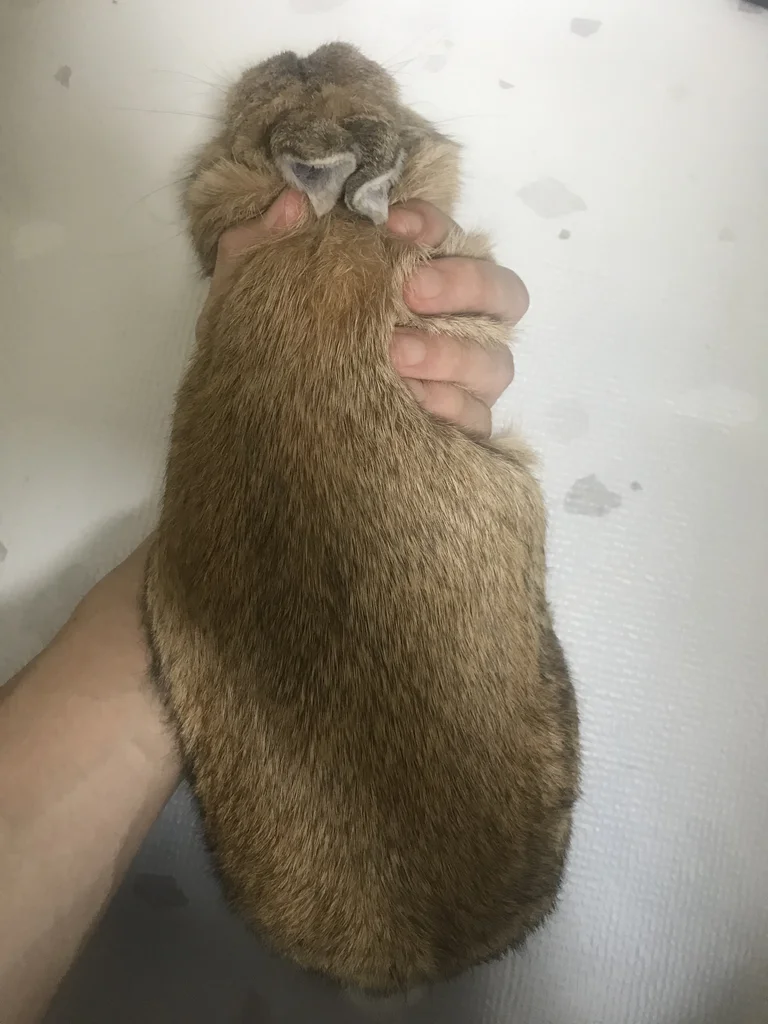
Step two: the hold itself. Once touch was boring everywhere, I added the pick-up, always the same way. While petting his head and back, I slide my left hand palm-up under his belly, securing his front legs and chest with my thumb, index and middle fingers. My right palm goes under his hindquarters and takes the weight. Then straight in against my chest, held close — no dangling, no open air under his feet.
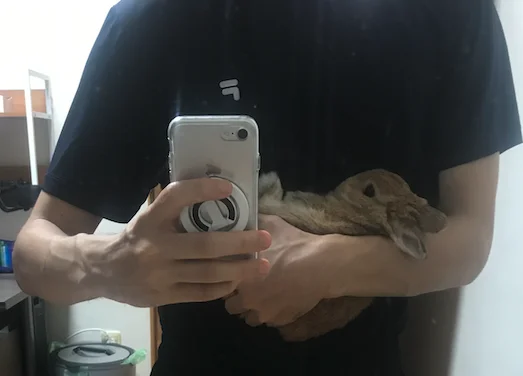
Step three: pay, then stop paying. During the training months, every hold ended with a treat, so the sequence read as “weird thing happens → snack appears.” These days there’s no payment. Being held is just a thing that happens sometimes, and he treats it that way.
Before all this, when I genuinely had to move him, I didn’t grab him — I’d drop a treat into his pet carrier bag, he’d hop in, and I’d move the bag instead of the rabbit. The bag still gets used, but since the training, moving him is a much smaller production.

He’ll never love being carried, and I don’t pretend otherwise. But for the moments it matters — health checks, nail trims, emergencies — he stays calm in my arms, and that’s the actual goal. Not cuddles. Cooperation.
What actually builds the bond, day to day
The milestones get the headlines, but they’re built out of boring daily deposits:
- Floor time. Sit on the floor and do nothing. Rabbits trust what’s at their level and ignore what looms. Do it long enough and the lap milestone arrives by itself — I never trained mine to sit on my lap; one day he just hopped up.
- Grooming. Once he tolerated brushing, our brush routine became bonding time disguised as maintenance — grooming is the same social currency as those rabbit kisses, flowing the other way.
- Treats, rationed. A treat from your hand teaches “human = good things.” I keep it boring and tiny — my whole philosophy is in the safe treats post — but as a trust tool, a few pellets from the palm punch far above their weight.
- Respecting the no. When he leaves, he leaves. Chasing a rabbit to continue petting it is a withdrawal, not a deposit.
The timeline, honestly
Two years in, here’s what I’d tell my past self: the affection is real, it’s just earned in months, not days. If your new rabbit ignores you for weeks — normal. If he takes treats but won’t be touched — normal, and progress. For mine, the rough map was: eats near me → takes treats from my hand → tolerates petting → first kisses around month four or five → calm in my arms around month six, after deliberate training. The bed-sleeping came later, in his free-roam year, entirely on his terms. Yours may shuffle the order, but the direction is the same: safety first, affection after.
A rabbit’s trust is slow, specific, and revocable — which is exactly what makes it worth more than the automatic kind.