Rabbit toy lists usually read like a pet store catalog: twenty items, all “great.” Here’s my version instead. My Netherland Dwarf’s entire toy collection is exactly two items — a plush carrot that’s been in daily rotation for about a year, and a snuffle ball that joined four months ago — and one confidently-purchased toy went in the trash after a single week. This post is all three stories, including the failure, because the failure taught me the most.
Winner #1: the little carrot plush
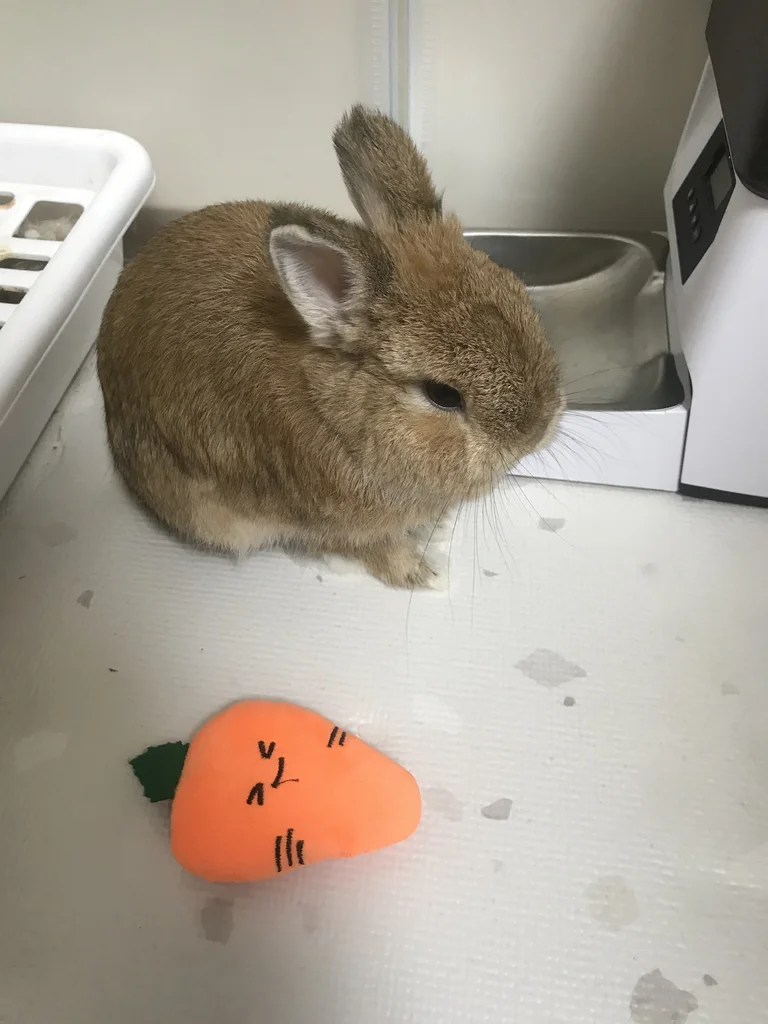
The first survivor is almost embarrassingly simple: a small carrot-shaped plush toy. No mechanism, no treats inside, nothing to figure out. It’s just his — a soft object he can pick up, toss, nudge around, and claim.
Our games with it are simple. If I hold the carrot up to his mouth, he gives it little licks — rabbit kisses. If I wiggle it across the floor in a slow S-curve, like a very unconvincing snake, then dart it toward him, he pops up and rakes it with his front claws. I like to tell myself this is snake-defense training; realistically, we’re both just having fun. And the part that actually melts me: when he hops past the carrot on his own, he’ll often stop and give it a quick lick too. It’s not just a toy he plays with — it’s a thing he seems to like.
What made it a keeper is exactly what makes it look boring on a shelf: it asks nothing of him. A rabbit toy doesn’t need features. It needs to be the right size for a rabbit’s mouth, safe to chew, and always available.
Winner #2: the snuffle ball
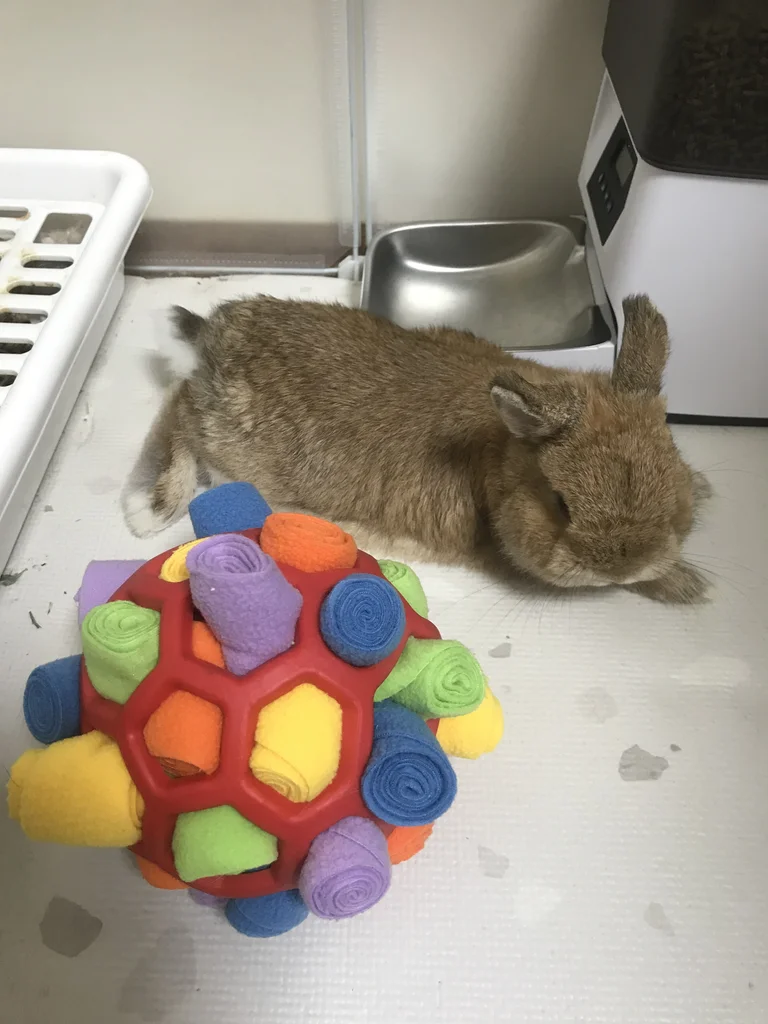
The second survivor works harder: a snuffle ball. It’s a soft rubber lattice shell stuffed full of rolled-up fleece strips, and I tuck a treat down between the rolls. He has to nudge the ball around, push his nose into the fleece, and tug the rolls aside to dig the treat out — a tiny foraging puzzle.
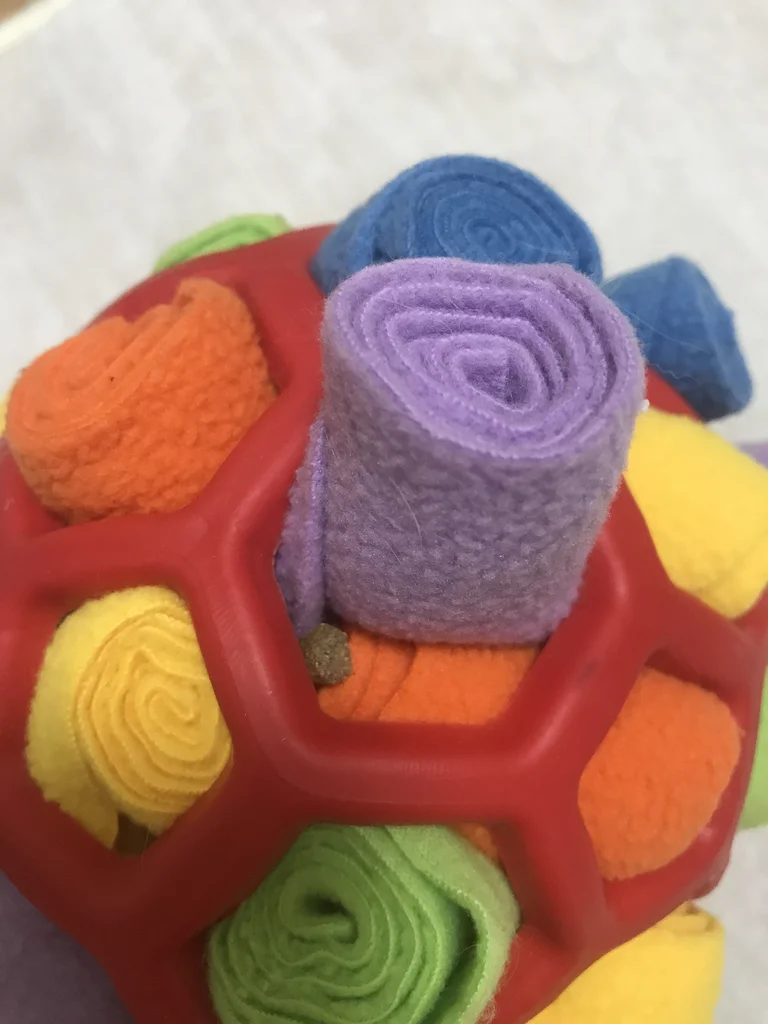
This is the toy I reach for when I want to engage him rather than just equip him. Foraging is what rabbits do all day in nature; a toy that makes food slightly inconvenient is speaking his native language. And it pairs perfectly with my boring-treats philosophy — what goes inside is a few Genesis pellets from his treat tin, and that’s all the motivation he needs.
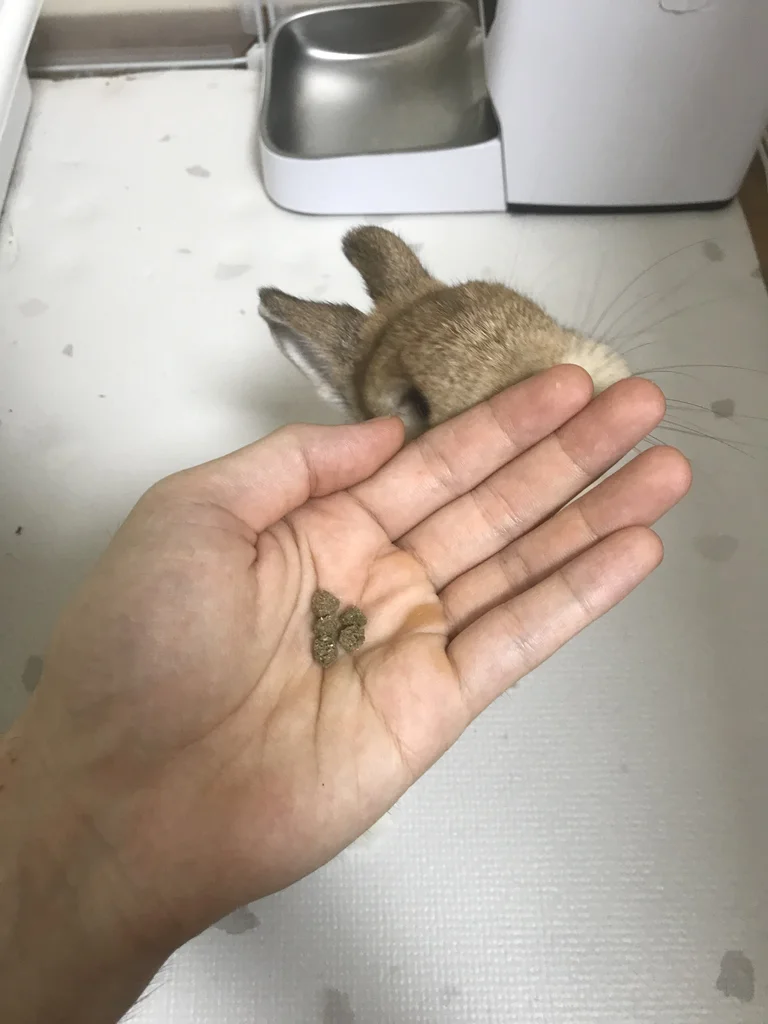
And here’s the part I didn’t expect: the ball gets used even when it’s empty. He’ll wander over on his own, give it a few licks the way he does with his carrot, rake it with his claws, or just tug the fleece rolls out one by one and leave the wreckage for me to reassemble. It seems to be his way of blowing off steam — part grooming target, part digging patch, part demolition project. A treat puzzle that still earns its floor space unloaded is a genuinely good deal.
The failure: a paw-shaped treat dispenser (for dogs and cats)
Now the one I got wrong. It was a plastic treat dispenser shaped like an animal paw — holes in the toes and pad, a sliding lid, clearly designed for dogs and cats. The idea: put treats in, pet works them out. Reviews were good. I bought it.
My rabbit had a different reading of the puzzle. Faced with a plastic obstacle between him and food, his solution was not to nudge and roll — it was brute force. He’d clamp the dispenser in his teeth, lift it, and slam it down against the floor, over and over, letting the impact bounce the treats out through the holes. As problem-solving, I have to admit, it was impressive. As a daily activity, it was hard plastic cracking against his teeth with every slam, with claw-raking and gnawing in between. Within a week I threw it out — not because it was destroyed, but because I could see exactly where this was heading. I didn’t want to find out which would chip first, a corner of the plastic or a tooth — and if the plastic went first, whether the piece would end up on the floor or in his stomach.
The lesson stuck with me: a dog sees a puzzle; a rabbit sees a wall to chew down. Dogs and cats manipulate objects with paws and give up on hard materials. A rabbit’s primary tool is a set of continuously-growing teeth that evolved to go through things. Hard plastic + food scent + rabbit = plastic shavings, and plastic isn’t something you want in a rabbit’s gut.
What the survivors have in common
Two winners and one loser is a small sample, but the pattern is loud:
- Soft, chew-safe materials won. Plush and fleece survive teeth or fail harmlessly, and the snuffle ball’s lattice is soft rubber, not something that chips. Hard plastic fails dangerously.
- Rabbit-logic beat feature-logic. The snuffle ball works because foraging is instinct — nose, licks, and tugging, no force required. The paw dispenser assumed paws; my rabbit substituted teeth and gravity, and that substitution was the whole problem.
- “For small pets” matters. My failure was a dog/cat product. The design assumptions simply don’t transfer to an animal that chews for a living.
Before buying any toy now, I ask one question: what happens when he decides to eat it? If the answer is “nothing good,” it doesn’t come home — no matter how clever the mechanism looks.
The bottom line
You don’t need a toy bin. My rabbit’s entire entertainment budget is one plush carrot and one snuffle ball — plus unlimited hay, which is honestly the real toy. Skip anything hard, anything plastic, and anything designed for a species with paws. Watch how your rabbit actually behaves, and buy for that animal, not the one in the product photos.
Usual disclosure: I bought all three of these myself, including the one that went in the bin. Especially the one that went in the bin.
This post is part of my complete rabbit setup — a tour of everything currently in his enclosure and why each item survived.